Outsourced SDRs: A Practical Guide for B2B Teams
A practical guide to outsourced SDRs covering in-house vs outsourced trade-offs, costs, KPIs, vendor selection, onboarding, and how to avoid common pitfalls.
Most advice about outsourced SDRs starts with the wrong question: “Which provider is cheapest?” That framing turns sales development into a staffing purchase. It also encourages vendors to optimize the easiest number to report, meetings booked, even when those meetings never become sales-accepted opportunities.
The better question is: Can this operating model create qualified pipeline that your sales team can convert? Outsourced SDRs can provide speed, process, and flexible capacity. They can also produce calendar noise, damage your brand, and leave you with unusable prospect data. The difference comes from measurement, qualification, and ownership, not from the word “outsourced” on the contract.
Table of Contents
- Why Outsourced SDRs Are Not Just a Cheaper Version of In-House
- What Outsourced SDRs Actually Are and How the Model Works
- In-House vs Outsourced SDRs
- Cost, Pricing Models, and Hidden Economics
- How LatHire Can Help
- KPIs and a Stage-Based Scorecard for Outsourced SDRs
- Selecting a Vendor and Running a Pilot That Actually Tells You Something
- Common Pitfalls, Data Risks, and How to Avoid Them
- Sample SLA, Playbook Outline, and a 90-Day Plan
Why Outsourced SDRs Are Not Just a Cheaper Version of In-House
Outsourcing sales development isn't just a cheaper way to employ an SDR. You're buying access to a prospecting system, including list building, sequencing, coaching, tooling, reporting, and replacement capacity. That system can be valuable when your team needs pipeline before it can justify building the whole machine internally.
The adoption data supports treating outsourced SDRs as a serious operating model, not a niche experiment. A 2025 industry report on outsourced SDR adoption cites a survey of more than 250 technology and high-growth companies, with 78.5% using an outsourced SDR agency in some capacity. The same source notes that estimates vary because some surveys count broad lead-generation work while others count dedicated SDR programs.

What the model buys you
A capable provider gives a lean B2B team several things it may not be able to build in a quarter:
- Faster deployment: You can launch prospecting with trained operators, existing workflows, and an established management layer.
- Predictable capacity: A retainer is easier to plan around than a sequence of recruitment, onboarding, ramp, and replacement decisions.
- Operational repetition: Providers see enough outbound activity to identify list, messaging, and channel problems quickly.
- Flexible experimentation: You can test a segment or geography without immediately committing to permanent headcount.
That doesn't mean the provider owns your go-to-market strategy. Your team still has to define the ideal customer profile, explain the product's value, approve the qualification standard, and accept or reject opportunities quickly. An external SDR can't rescue unclear positioning or a product that nobody wants.
The contrarian frame: Outsourcing doesn't remove the sales-development problem. It moves the problem from hiring to instrumentation.
The decision is about evidence
Treat the provider as an operating partner with a measurable funnel. Judge the program by held meetings, sales-accepted leads, opportunity creation, and sourced pipeline. Meeting volume belongs in the dashboard, but it shouldn't sit at the top of the decision hierarchy.
This mindset also prevents a common mistake. A low-cost provider may look efficient if it reports a large number of booked meetings. If your account executives reject those meetings, your actual cost per opportunity rises while internal trust falls. The right outsourced SDR program may generate fewer appointments and more usable pipeline.
What Outsourced SDRs Actually Are and How the Model Works
An outsourced SDR is an external sales development representative or team that prospectively identifies accounts, contacts buyers, runs outreach, qualifies interest, and creates sales conversations for your company. The provider usually supplies the people, management, workflows, and technology, while your team supplies product context, target-account criteria, and the handoff process.
That definition matters because vendors use similar language for very different services.
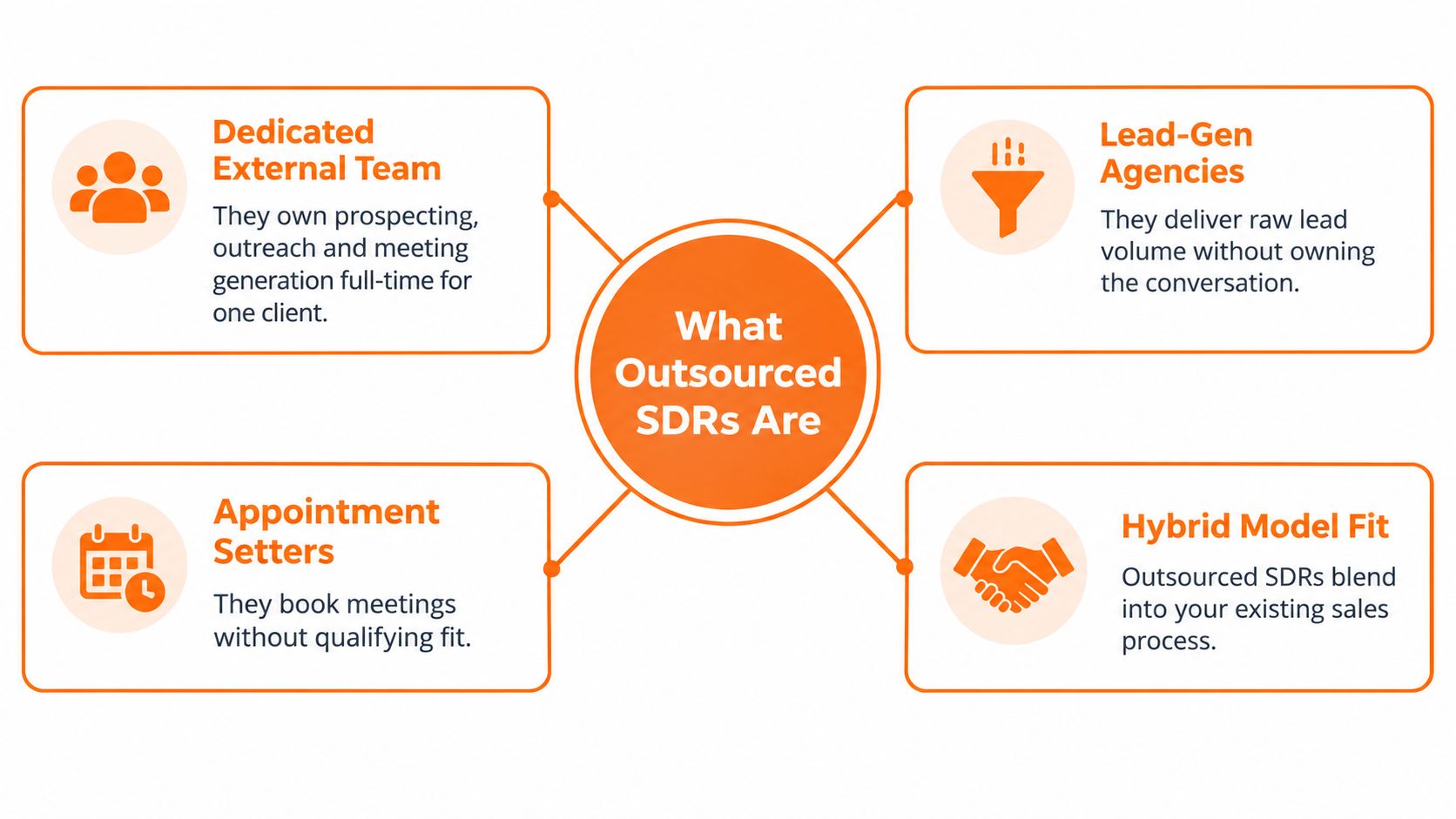
Separate the operating models
Lead-generation agencies may deliver contact lists or raw responses without owning the conversation. Appointment setters may schedule calls but lack a meaningful qualification responsibility. A B2B call center typically prioritizes call handling or activity volume, which isn't the same as running a researched, multi-touch sales-development motion.
A proper outsourced SDR engagement should define who owns:
- Account selection, including the industries, company characteristics, roles, and buying signals that determine fit.
- Research and messaging, including the evidence an SDR may use and the claims they may make.
- Outreach execution, across approved channels and sequences.
- Qualification, using fields agreed with your sales team before launch.
- Handoff and attribution, so your account executives know why the prospect belongs in their pipeline.
The staffing shape also changes the economics. A dedicated team focuses on one client and is usually the best fit when the provider must learn a specialized market. A shared team spreads capacity across accounts and can suit simpler motions, but you need to understand how attention and reporting are divided. A project-based pilot limits commitment while you test an ICP, offer, or geography.
How integration should work
The provider should work inside, or in close sync with, your CRM. That means consistent lifecycle stages, disposition reasons, meeting outcomes, ownership rules, and source fields. If the agency keeps the actual activity data in a separate system, you can't reliably compare its output with internal sales activity.
Your broader revenue stack still matters. Marketing supplies positioning and proof. RevOps controls routing, definitions, and reporting. Account executives handle discovery and progression. The outsourced SDR sits at the front of that system, not above it.
For lean teams that need administrative help around outreach or scheduling, it can be useful to compare the role with other external support options in this guide to virtual assistant services. A virtual assistant may improve execution capacity, but that isn't the same as owning qualified pipeline creation.
In-House vs Outsourced SDRs
The better question is whether the operating model creates qualified pipeline that your sales team can convert. In-house hiring provides direct control and institutional knowledge. Outsourcing provides speed, management infrastructure, and a controlled way to test whether a sales motion deserves permanent investment.
| Dimension | In-House SDR | Outsourced SDR |
|---|---|---|
| Cost structure | Salary, benefits, tools, management, recruitment, and ramp | Service fee plus internal coordination and integration costs |
| Time to productivity | Slower because you recruit and train from scratch | Faster when the provider has trained staff and a working process |
| Messaging control | Direct daily control and rapid internal feedback | Shared through briefs, reviews, and approved messaging |
| Product expertise | Deepens inside the company over time | Depends on onboarding quality and provider specialization |
| Manager overhead | Your team owns coaching, performance, and replacement | Provider manages daily execution while you own alignment |
| Data and tooling | Full internal control when systems are configured well | Requires clear access, export, ownership, and compliance terms |
| Long-term team building | Creates a career path and internal sales culture | Adds external capacity, but not necessarily internal talent |
| Market testing | More expensive and slower to reverse | Easier to scope as a segment or campaign pilot |
When internal hiring wins
Choose in-house SDRs when the role demands deep product learning, complex discovery, or sustained account knowledge. Internal reps fit especially well when they work closely with account executives through a long sales cycle or serve as a feeder path for future sellers.
Internal hiring also makes sense when you already have an experienced SDR manager and a documented playbook. You are adding capacity to an operating system that already exists, rather than asking a new employee to build the process while learning the product.
The tradeoff is management ownership. Your team handles recruiting, ramping, coaching, performance issues, and replacement. Those responsibilities create value when the role is strategic and durable, but they become expensive if the market, offer, or qualification rules are still changing.
When outsourcing wins
Outsourcing is the stronger first move when you need pipeline quickly, lack SDR management expertise, or want to test a segment before adding headcount. It also suits a launch, a new market, or a defined campaign that does not justify a permanent team.
My recommendation is direct: if your ICP and offer are still uncertain, don't build a large internal SDR team first. Use a tightly scoped outsourced pilot or founder-led selling to learn which accounts respond, which messages earn replies, and whether accepted meetings progress after handoff. Judge the provider on downstream opportunity quality, not booked-meeting volume.
Once the motion produces repeatable opportunities, bring strategic and complex work in-house. A hybrid model can then work well: internal reps own strategic accounts and nuanced discovery, while outsourced SDRs cover a narrower, repeatable segment.
That arrangement requires shared definitions, CRM stages, qualification rules, and ownership. Without them, two teams can report activity while producing incompatible pipeline. With them, the comparison becomes measurable: conversion by stage, sales acceptance, opportunity progression, and revenue contribution.
Cost, Pricing Models, and Hidden Economics
Outsourced SDR pricing becomes misleading when you compare retainers instead of usable opportunities. Reported SaaS sales-outsourcing benchmarks place a dedicated outsourced SDR at roughly $3,000 to $8,000 per month, compared with approximately $9,800 to $14,200 per month for a fully loaded in-house SDR, according to reported SaaS sales-outsourcing benchmarks. That creates a possible monthly difference of about $1,800 to $11,200 per representative, before differences in scope, quality, management, and conversion.
Another estimate puts typical outsourced engagements at $4,000 to $12,000 per month per SDR-equivalent. The range is wide because providers sell different combinations of staffing, list building, messaging, tools, management, and reporting. A headline monthly fee means little until the delivery specification is clear.
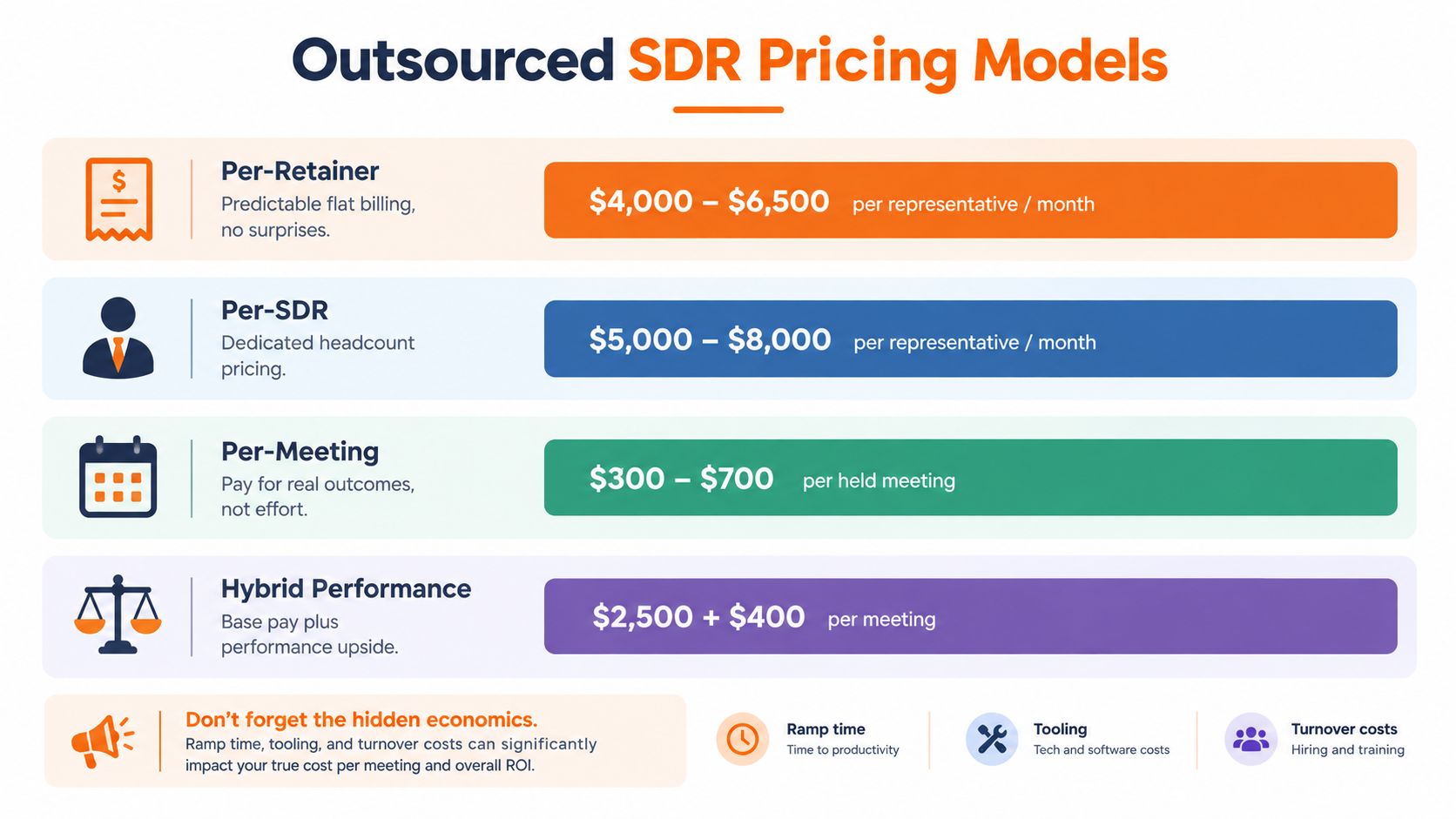
Understand the pricing structure
Common models include:
- Retainer: You pay for a defined program with agreed staffing and services. This makes budgeting easier, but the SLA must specify activity, quality, reporting, and acceptance criteria.
- Per SDR: You pay for dedicated capacity. Confirm whether management, data, software, replacement coverage, and reporting are included.
- Per meeting: The provider earns when a meeting is booked or held. This can reward volume while weakening qualification, so define account fit, contact seniority, attendance, and sales acceptance.
- Hybrid performance: A base fee covers operating costs, with additional payment for accepted outcomes. This model works when attribution, qualification, and CRM stages are agreed in advance.
A useful provider benchmark targets roughly 8 to 15 qualified meetings per month and $50,000 to $150,000 in monthly pipeline for a productive representative, as reported in the same source. Treat those figures as planning references, not commitments. For broader context on separating service fees from operating inputs, see this guide to pricing social automation services.
Calculate the true cost
Your spreadsheet should include:
- Internal sales-leader time for onboarding and weekly reviews.
- CRM integration and reporting work.
- Contact-data purchases and list refreshes.
- Deliverability and sequencing tools.
- AE time spent on meetings that fail qualification.
- Delayed pipeline caused by incorrect targeting or messaging.
- Rework after inaccurate records enter the CRM.
Compare total program cost with held, sales-accepted opportunities, not booked appointments. Salary-only comparisons make internal teams look cheaper, while retainer-only comparisons make outsourced teams look cheaper. Neither measures commercial value. The useful figure is the amount required to create an opportunity your sales team would genuinely pursue.
A low price works only when downstream conversion holds. If it does not, the provider has shifted its efficiency problem to your account executives. Judge the engagement by stage progression and pipeline quality, then use meeting volume as an operating input rather than the final score.
How LatHire Can Help
LatHire connects US and Canadian companies with pre-vetted Latin American professionals across sales, marketing, technology, and operations. Its platform combines AI assessments, skills evaluations, and human-led background checks, then matches companies with available candidates in their time zone. LatHire says its talent pool includes more than 800,000 candidates, and it supports hiring, HR, international payroll, benefits, and compliance in one workflow.
That model solves a different problem from a traditional outsourced SDR agency. You aren't buying a fully managed appointment-setting program. You're building external capacity while retaining more control over the person, process, CRM, and messaging.
Where the model fits
LatHire is a practical option when you have a manager or founder who can coach an SDR, your qualification process is documented, and you want a flexible team member rather than a black-box vendor. It can also suit companies that want to build a hybrid model, with internal ownership of the CRM and playbook while sourcing talent internationally.
The trade-off is management. A recruited SDR still needs onboarding, daily direction, call review, messaging feedback, and performance management. If you need those functions handled for you, a managed outsourced SDR provider may be the better fit.
For teams comparing talent-sourcing options, LatHire's best place to hire SDRs resource is useful for evaluating candidates and engagement structures. Use it as a hiring input, not as a substitute for a scorecard.
KPIs and a Stage-Based Scorecard for Outsourced SDRs
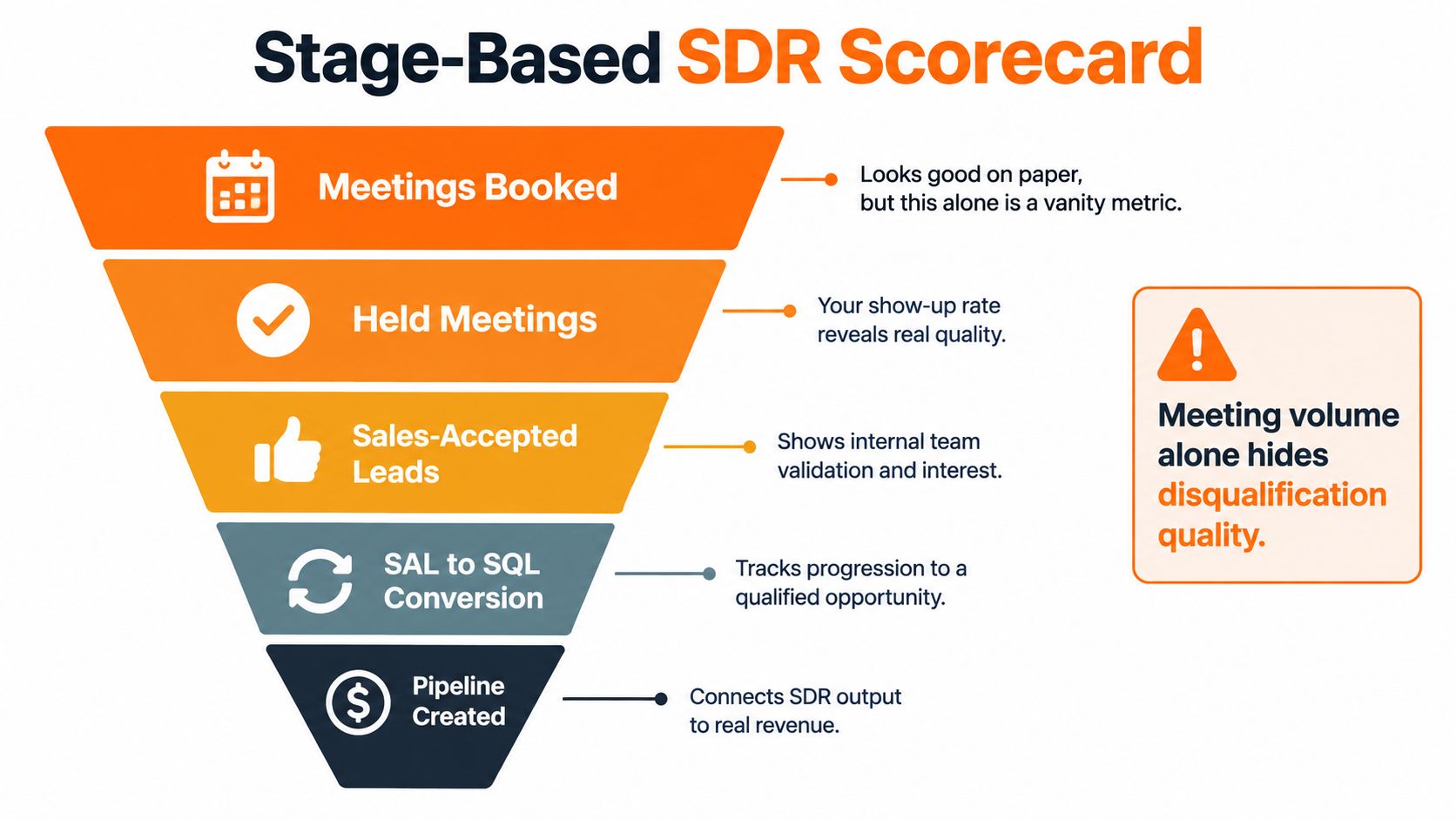
Meeting volume is a poor primary KPI because it measures the easiest funnel stage to inflate. A provider can fill calendars with weak-fit accounts, collect its fee, and leave your sales team to manage the fallout. Judge outsourced SDRs by progression through the funnel, not by appointments alone.
Track the progression
Meetings booked measures calendar activity. Keep it visible, but attach no reward to it without downstream quality checks.
Held meetings reveal show rate and basic buyer commitment. One benchmark describes approximately 15 booked meetings per month with an 80% show rate, or about 12 completed meetings. Another reports roughly 9.4 qualified meetings per SDR per month in available SDR benchmark guidance. Those figures are not interchangeable. Definitions, segments, offers, and qualification standards determine what the output means.
Sales-accepted leads indicate whether your sales team agrees that a conversation meets the qualification standard. Define acceptance rules before launch, including required role, account fit, business problem, and next-step evidence.
SAL-to-SQL conversion tests whether accepted conversations become genuine sales-qualified opportunities. Break the rate down by ICP segment, role, and source so weak targeting does not hide inside an average.
Opportunity creation marks the point where the program starts producing pipeline rather than appointment activity.
Sourced pipeline and revenue influenced connect SDR work to commercial results. Write the attribution rule before launch, especially when founders, marketing, account executives, and the provider all engage the same account.
Set the ramp expectation
Do not judge a new program after a few weeks unless the provider claims the segment requires no learning. Earlier ramp-benchmark research estimates roughly 3.2 months to the first qualified meeting and up to 5.5 months to full quota capacity. Your agreement can still require early instrumentation, accurate CRM records, and evidence of activity while the team learns.
Audit outcomes weekly. Review a sample of booked and held meetings, inspect qualification fields, and compare accepted opportunities with account executive feedback. If booked volume rises while held meetings or opportunity creation falls, investigate list quality and incentive design before calling the program a success.
Set a target at every stage. Each meeting goal needs a corresponding acceptance target and opportunity target, or the provider can optimize for calendar volume while your pipeline deteriorates.
Selecting a Vendor and Running a Pilot That Actually Tells You Something
A good vendor selection process starts with evidence, not a polished sales deck. Ask providers to show the exact reporting fields they use, explain who reviews calls, and describe how they handle a prospect who fits the account profile but lacks urgency or authority.
Request artifacts before signing:
- A sample dashboard: It should separate booked, held, accepted, qualified, and opportunity stages.
- Recorded call examples: You need to hear research quality, discovery behavior, and how reps handle objections.
- A qualification rubric: Generic phrases such as “decision-maker interested” aren't enough.
- A sample account list: Review company fit, role selection, and exclusion logic.
- A data-flow explanation: Identify where contact records, call recordings, messages, and opt-outs live.
Design a useful pilot
Run the pilot against one ICP, one offer, and a defined set of qualification fields. A 60 to 90 day pilot gives the provider time to establish the process while preserving your ability to stop, adjust, or renegotiate. Set thresholds for held meetings, sales acceptance, opportunity creation, and data completeness.
Don't let the provider change the audience halfway through and then present blended results. If you change the ICP, record the change and separate the cohorts.
Onboarding should include:
- A written ICP and account-exclusion list.
- Approved messaging pillars and prohibited claims.
- CRM access, field definitions, routing, and attribution rules.
- A call-review process with named owners on both sides.
- A weekly meeting-quality review.
- A documented escalation path for legal, brand, or customer-sensitive issues.
Disqualify weak partners
Walk away when a provider refuses to share activity-level data, can't explain qualification, or only offers vague success stories. Be especially cautious when the vendor guarantees appointments but avoids commitments around held meetings or opportunity quality.
AI-assisted outreach raises the standard further. Require human approval for claims about your product, customer outcomes, integrations, pricing, or compliance. Your provider should be able to show prompts, generated messages, edits, and the final version sent to each segment.
The pilot succeeds when both sides learn something durable. You should finish with a clearer ICP, tested messaging, clean attribution, and enough downstream evidence to decide whether to scale.
Common Pitfalls, Data Risks, and How to Avoid Them
The costliest failure is good-looking activity aimed at the wrong buyers. Qualification is a brand and revenue control, not an administrative task. A provider can report busy SDRs while damaging your market position if its first conversations reach poor-fit accounts or create expectations your sales team cannot support.
Treat the problem as measurement. Track whether records are accurate, outreach follows approved rules, conversations meet qualification standards, and accepted meetings progress into opportunities. Meeting volume without downstream evidence is a provider performance issue, not a success metric.
Protect the data chain
Your contract should state who owns and controls:
- Contact records and enrichment history.
- Suppression lists and opt-out evidence.
- Call recordings and transcripts.
- Prompts, generated copy, edits, and message history.
- CRM activity, dispositions, and attribution fields.
- Audit logs and export files at termination.
Define controller and processor roles, geographic transfer safeguards, retention periods, deletion rights, and suppression-list synchronization. “GDPR compliant” or “CCPA compliant” means little unless the provider explains the workflow, evidence, and owner for each requirement.
Data quality also requires a refresh policy. Ask how often records are updated, how contacts are verified, how invalid details are corrected, and what happens after an opt-out. Require the provider to record source, verification status, last-checked date, and disposition reason so your team can audit performance by cohort.
Use a practical control list
Before launch, confirm:
- Access: You can export campaign and contact data without vendor assistance.
- Suppression: Opt-outs synchronize across every sending and calling system.
- Approval: A human reviews AI-generated claims before distribution.
- Security: Recordings, transcripts, and prompts have defined access controls.
- Attribution: The contract explains how shared influence is recorded.
- Termination: The provider deletes or returns data within a documented period.
- Reporting: Your team receives raw activity and outcome data, not only summaries.
Keep CRM integration simple and auditable. A practical guide to integrating a CRM with social automation illustrates the broader principle: systems should exchange structured data with clear ownership rather than create another reporting island.
Review the scorecard by stage. If contact accuracy falls, fix the list. If accepted meetings fail to progress, revisit qualification and messaging. If opportunities lack clean source data, fix attribution before expanding the program. This approach judges an outsourced SDR provider on pipeline quality, not activity theater.
Sample SLA, Playbook Outline, and a 90-Day Plan
You don't need a complicated contract. You need an SLA that makes quality observable and gives both sides a way to correct failure.
Sample SLA skeleton
Scope: Define the ICP, geography, personas, channels, campaign exclusions, staffing model, and account ownership.
Deliverables: Specify list creation, research, outreach, call activity, meeting handling, CRM logging, recording access, reporting, and weekly reviews.
Qualification: Name the required fields, including buyer role, company fit, current workflow, pain, urgency, authority, and agreed next step.
Reporting: Require booked meetings, held meetings, show rate, sales-accepted leads, SAL-to-SQL conversion, opportunities, sourced pipeline, disposition reasons, and data-completeness checks.
Data ownership: State that your company owns records, suppression lists, recordings, transcripts, campaign history, prompts created for the engagement, generated messages, and performance data, subject to applicable law.
Governance: Define security responsibilities, privacy roles, retention, deletion, international transfers, AI review, and incident escalation.
Performance remedies: Include a correction plan for poor data quality or missed reporting, replacement terms for underperforming staff, and a remedy that addresses invalid meetings rather than just adding more appointments.
Termination: Set notice, export, handoff, deletion, and active-opportunity treatment. Don't leave account history trapped in a vendor portal.
Lightweight playbook outline
Start with the ICP definition. Document firmographic fit, disqualifiers, buying roles, trigger events, and account tiers.
Then create messaging pillars. Give SDRs a problem statement, a proof point, a reason to act now, and a clear next step. Separate messages for founders, creators, agencies, and lean marketing teams when their workflows differ.
Define the channel mix and sequence rules next. State which channels are approved, what personalization is required, when a rep stops outreach, and how opt-outs are recorded.
The qualification rubric should read like a decision tool, not a paragraph of marketing language. Require evidence for pain, current process, urgency, authority, and fit.
Finally, document escalation rules. A rep should know when to involve an AE, pause an account, request legal review, or reject a meeting.
A 90-day operating plan
Weeks one to four, instrument the system. Finalize the ICP, qualification fields, account list, messaging, CRM stages, attribution rules, and reporting view. Review early calls for data quality and message accuracy. Don't judge commercial success before the measurement layer works.
Weeks five to eight, run controlled tests. Keep account lists and messaging variants separate so you can compare held-meeting rate, sales acceptance, SAL-to-SQL conversion, opportunity rate, and pipeline per 1,000 contacts. The outbound metrics guidance from UpliftGTM reports cold-call connect rates around 3% to 10%, approximately 2.3% of dials converting into booked meetings, email positive-reply rates commonly at 1% to 3%, and 3% to 6% as a good range. Use these as diagnostic context, not guarantees.
Weeks nine to twelve, make the decision. Review cohorts, not blended averages. Compare segments, channels, reps, show rates, acceptance, opportunity creation, and pipeline. If the program produces meetings but no qualified opportunities, change the audience or qualification before adding volume. If it creates durable opportunities and clean data, negotiate the next phase from evidence rather than momentum.
The operator's rule is simple: scale the process that creates accepted opportunities, not the provider that fills calendars.
If you're building a lean revenue engine, use the same discipline for every growth workflow, clear ownership, clean data, human review, and reporting tied to outcomes. Quuu can help you maintain consistent brand content across X, LinkedIn, Facebook, and Bluesky while your team focuses on the conversations that create pipeline. Explore Quuu and connect your profiles to start generating, reviewing, scheduling, and publishing from one workspace.