7 Best Facebook Ads Agencies for Growing Brands in 2026
Compare the best Facebook ads agencies by pricing, specialization and fit, plus how to choose the right one for your goals and budget.
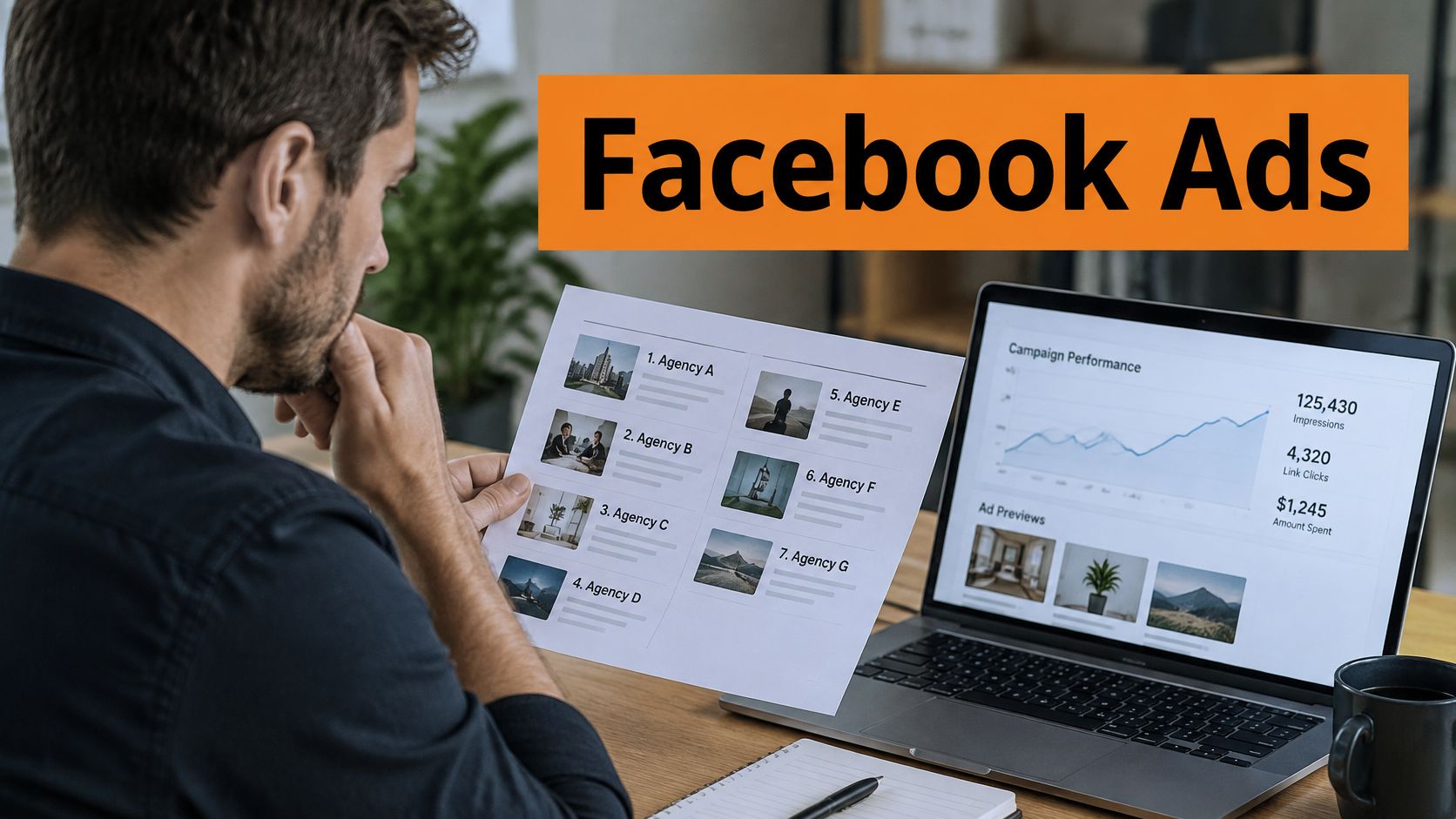
What makes a Facebook ads agency the best one for your brand? Most "best Facebook ads agencies" roundups answer with client logos, award badges, and one headline ROAS number. None of that tells you whether the agency would do right by a business spending $6,000 a month, or whether it has ever run a holdout test.
Scale explains why the category exists at all. WARC Media forecast that Facebook would generate $100.1 billion in global advertising revenue in 2024 and $112.8 billion by 2026, according to Statistics Global's Facebook advertising figures. The same analysis notes Facebook held nearly 89% of the global social ad market in 2013, with its share expected to fall to 38.2% by 2025 as Instagram and TikTok expanded. Agencies built for one channel in one era aren't automatically built for this one.
So a flat ranking is the wrong shape for this decision. The agencies below split by spend band and business model instead: sub-$5,000 local advertisers, $5,000 to $25,000 growth accounts, and six-figure ecommerce programs. An agency that serves $3,000-a-month advertisers should not be running a $150,000-a-month account, even when both appear on the same list.
Find your band, read the two or three entries in it, then verify four things before signing: who owns the ad account and pixel, how many net-new creative concepts arrive each month, whether incrementality testing is part of the engagement, and what the notice period is.
Table of Contents
- 1. Knowlify
- 2. LYFE Marketing
- 3. Sociallyin
- 4. Black Propeller
- 5. Disruptive Advertising
- 6. HawkSEM
- 7. Common Thread Collective
- 8. Tinuiti
- Best Facebook Ads Agencies at a Glance
- How to Choose and What to Do While Ads Run
1. Knowlify
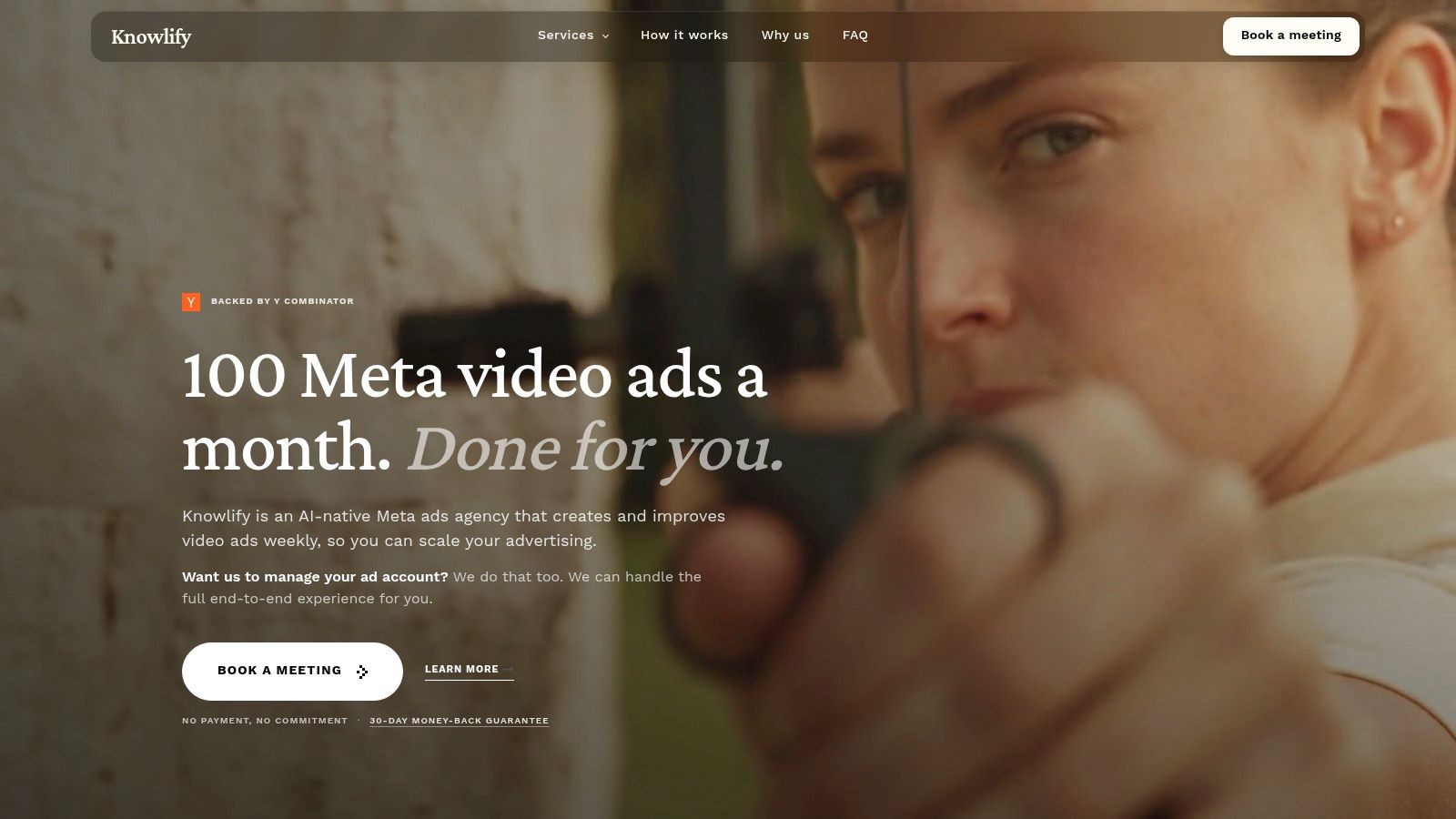
Knowlify is a done-for-you AI video advertising agency for B2B and B2C companies running paid social, and it attacks the constraint that caps most Facebook accounts: not enough fresh creative to feed the auction. Media buying is a solved discipline for anyone competent. Ad supply is not. The average click-through rate for Facebook traffic campaigns was 1.57% across industries in 2024, based on 2,946 campaigns analyzed by WordStream's Facebook ads benchmarks, and accounts shipping one hero ad a month rarely beat that for long.
What Knowlify Actually Produces
Knowlify makes AI UGC ads, Pixar-style character animation ads, and AI commercials. It handles concepts, scripts, production, editing, and sound, and every finished ad gets a human quality check before delivery.
The cadence is the interesting part. A 20-minute kickoff call covers product, audience, goals, and brand assets. Creative direction comes back for approval within 48 hours, and the first finished batch lands five days after that call. On monthly plans, new batches arrive weekly at about 25 finished ads per week, and campaign results feed the next round of concepts.
That volume changes the shape of an account. Instead of one hero asset and three variants, you're running genuine concept tests across hooks, formats, and angles in the same month.
Where Knowlify Fits
You can take creative production alone and keep your existing media buyer, or combine it with end-to-end Facebook and Instagram campaign management. Media spend sits outside the fee, and you keep your ad accounts and every finished ad, which matters when you eventually move.
Practical rule: judge a creative partner on net-new concepts per month, not assets per month. Twenty-five variations of one script is one idea.
The honest trade-off is category depth. Knowlify is backed by Y Combinator (Summer 2025) and is early in its life, so ask for work in your vertical before committing a quarter's budget. Choose it when creative volume and cost per asset are the bottleneck. Pass when you need one team to own landing pages, CRO, and analytics as well.
See current examples and book a call on Knowlify's Meta ads agency page.
2. LYFE Marketing
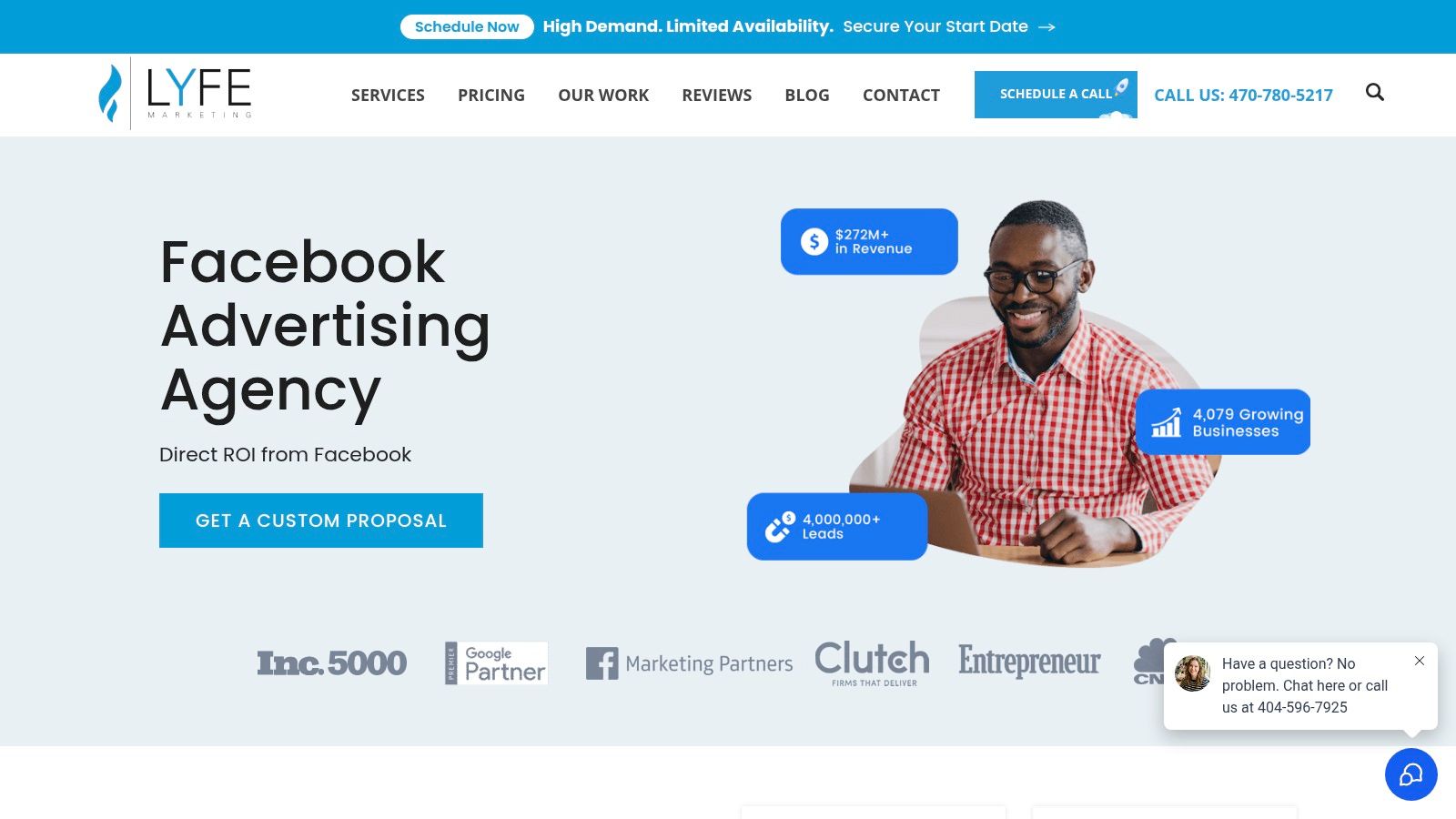
LYFE Marketing runs Facebook and Instagram campaigns for small and midsize businesses, and it publishes its pricing, which is rarer than it should be. Its broader digital advertising management starts at $750 per month plus ad spend, with a $300 setup fee that may apply or be waived, according to LYFE Marketing's Facebook ads agency page.
At that level the math is unforgiving. The average cost per click for Facebook traffic campaigns was $0.77 across industries in 2024, per PPC Land's summary of WordStream's benchmark report, so a $2,000 monthly media budget buys roughly 2,600 clicks before a single conversion. Every dollar of management fee competes directly with media.
What You Get
Services include campaign strategy, ad creation, geotargeting, conversion tracking, weekday monitoring, retargeting, and reporting. LYFE also runs organic social media management, which helps if you'd rather one vendor handle the page and the paid push.
Three things belong in the proposal:
- A written task list: published package details may not specify every deliverable for your particular campaign.
- The term in writing: the broader digital advertising service describes an initial 90-day commitment before moving month to month.
- Fee confirmation: establish whether the setup fee applies to your package and what triggers it.
Before you sign, look at what competitors are running. Working through the best Meta ad library tools for marketers lets you audit live creative in your category and judge whether the ads an agency brags about hold up.
Who It Suits
Pick LYFE when you're spending under roughly $5,000 a month, want paid and organic social from one team, and prefer a published price to a discovery call. Look elsewhere once you need incrementality testing, server-side tracking, or a dedicated creative studio, because the package structure stops scaling with you.
3. Sociallyin
Sociallyin is the growth-stage option: paid campaigns across Facebook, Instagram, and other platforms, with creative produced by an in-house studio. Strategy, targeting, optimization, and reporting sit with the same team that makes the ads, which removes the usual handoff between buyer and designer.
The agency says most engagements range from $5,000 to $50,000 or more, with consulting packages starting at $1,500, per Sociallyin's paid social advertising page. Confirm in the proposal whether ad spend is billed separately.
The Fee Structure Question
That range sits exactly where fee architecture matters more than hourly rate. Agency fees commonly take the form of a percentage of media spend, a flat retainer, a performance component, or a project fee, and indicative published ranges run from roughly 10% to 20% of ad spend, $1,000 to $7,500-plus monthly retainers, and $100 to $300 hourly or project rates, according to GrowthHit's guide to Facebook ads agency pricing. Those figures are planning ranges, not universal prices, and they usually exclude the budget paid straight to Meta.
A percentage-of-spend fee pays the agency more as you spend more, even when the next $20,000 returns less than the last $20,000. Ask what happens to the rate when returns flatten.
Engagements are described as month to month with 30 days' notice, which suits brands that expect to change course. The agency also offers organic social, community management, and influencer marketing, useful if you want one partner across the whole social surface rather than paid only.
What the Range Doesn't Tell You
The catch is definition. A $5,000 engagement and a $50,000 engagement are often not the same product with more hours attached, so ask for the deliverable list line by line and compare creative volume, not just channels covered.
If your organic presence is thin, fix that before you scale paid. This guide to growing a Facebook page in 2026 covers the groundwork that makes paid traffic convert at a sane cost.
4. Black Propeller
Black Propeller sets a hard floor: it works with brands spending at least $10,000 per month on paid media, with custom retainers based on ad-spend bands. That number filters out most first-time advertisers, and it's the honest way to state a minimum rather than burying it in a call.
Above the floor sits a combined media and creative shop. Meta campaign strategy, audience research, testing, and budget pacing run alongside in-house static, animated, video, and carousel ad production. Conversion tracking, reporting dashboards, and regular client meetings are included, and clients retain ownership of their accounts and produced creative.
Why the Floor Exists
Below roughly $10,000 a month in media, a testing program can't breathe. You need enough budget to run several concepts at once, enough conversion volume for Meta's system to exit the learning phase, and enough headroom to cut losers without stalling the account. A $3,000 budget split across four ad sets tests nothing.
Black Propeller also buys on TikTok, LinkedIn, Pinterest, and Reddit. For a brand whose Facebook costs keep climbing, that diversification has practical value, though it also means your Meta account competes internally for senior attention.
Evidence and Terms
The agency publishes a Meta case study for MISSHA reporting $103,310 in revenue at 5.38 ROAS, per Black Propeller's paid social page. Treat one case study as a demonstration of method, not a forecast, and ask for two more in your category with spend levels attached.
Month-to-month arrangements are described as possible. Get that in writing with the notice period, and confirm the ad account and pixel stay in your Business Manager.
Ask before signing: who makes the creative, and how many net-new concepts per month come with the retainer?
Choose Black Propeller when you're above the threshold and want media buying and performance creative under one roof. Below it, the minimum alone ends the conversation, and a smaller shop will do comparable work without the premium.
5. Disruptive Advertising
Disruptive Advertising runs Facebook and Instagram campaign strategy and management inside a broader digital advertising and conversion optimization practice. Its dedicated service page identifies the agency as a Meta Business Partner, and pricing arrives through a custom proposal.
That structure suits a specific buyer: a business that wants paid social coordinated with paid search, landing page testing, and conversion work, rather than an agency that only touches Meta.
The Case for One Team Across Channels
When Facebook and Google are managed separately, both teams claim the same conversion and neither owns the overlap. One team, one attribution model, one set of landing pages ends that argument. The trade-off is depth. A broad practice may not carry the creative production volume a Meta-only studio brings, so ask how many new ad concepts ship each month and who writes them.
What to Pin Down
Disruptive doesn't publish Facebook Ads management pricing, so the proposal is where the comparison happens. Three items belong in it:
- Team composition: the name and seniority of the person running your account week to week, not the person who pitched.
- Deliverables: creative volume, landing page work, tracking setup, and reporting cadence, each with a number attached.
- Scope against your needs: a broad service range can exceed what a business seeking basic campaign management requires, and you pay for the parts you don't use.
For a simple funnel on one channel, that overhead is real money. For a business with a leaky landing page and a paid search program that overlaps with Meta, the coordination is worth the premium.
See current scope and service details on Disruptive Advertising's Facebook and Instagram advertising page.
6. HawkSEM
HawkSEM publishes price bands, which makes it one of the easier agencies to evaluate before you get on a call. Its general paid-social guidance runs $2,000 per month for starter plans, $3,450 for full-service management, and $10,000 or more for larger brands, with no setup fee stated, per HawkSEM's paid social agency page.
Services cover Facebook and Instagram campaign management, creative support, testing, and reporting. The agency also offers a free audit and proposal process, which is worth taking even if you hire someone else, provided you show up with a specific question.
What the Free Audit Is Worth
An audit that lists "improve targeting" and "test more creative" is a brochure. An audit that names the campaigns with the weakest cost per acquisition, the ad sets stuck in learning, and the events missing from your pixel is diagnostic work.
Audit test: ask them to name three specific ad sets to pause and the reason for each. Vague answers mean the audit was templated.
Published prices are guidance, not a quote, and they may cover services beyond Facebook alone. Confirm what a $3,450 engagement includes for a Meta-only program: creative volume, channel scope, and measurement.
Where HawkSEM Fits
This sits comfortably in the growth-stage band, roughly $5,000 to $25,000 in monthly media. Below that, the fee outweighs the media and a smaller shop or a hybrid setup does more per dollar. Well above it, you're paying for a team that may be stretched across too many accounts.
Paid social doesn't have to be the only way you distribute. If you're weighing distribution options, this comparison of when to use Quuu Promote vs ads breaks down what each route does for reach versus direct response.
7. Common Thread Collective
Common Thread Collective is built for ecommerce brands, and its stated threshold is $100,000 or more per month on Meta, per Common Thread Collective's Meta ads page. Pricing is customized. That threshold is the clearest disqualifier on this list, which is useful: most readers can rule it in or out in one second.
The service combines media buying with creative strategy, financial forecasting, spend modeling, and analysis tied to contribution margin and customer lifetime value rather than platform-reported ROAS.
Why Incrementality Is the Real Filter
Incrementality testing randomly withholds ads from a control group and compares outcomes against an exposed group; the difference estimates what the advertising caused. That distinction matters because Meta attribution can overlap with email, organic search, direct traffic, and demand that already existed.
Most agency roundups skip the question entirely. They show client lists and case-study ROAS without saying whether the agency can prove its ads created conversions rather than taking credit for customers who would have bought anyway. The Meta for Business note on agencies testing incrementality walks through the holdout approach.
An agency reporting a lower, experimentally validated ROAS is often worth more than one reporting a higher platform-attributed number.
Where the Threshold Points
Choose Common Thread when you're a funded ecommerce brand at a scale where contribution margin, payback period, and lifetime value decide budget, not last-click ROAS. Its ecommerce specialization is a genuine asset and a genuine limit: a B2B lead-gen program with a long sales cycle needs different math.
Before signing, ask two things. How often do you run geo-experiments or conversion lift studies, and do you report confidence intervals or only point estimates?
8. Tinuiti
Tinuiti runs Meta advertising inside a large paid-media practice, covering full-funnel customer acquisition and re-engagement, creative strategy, media allocation across Facebook and Instagram placements, and measurement. Pricing is custom through a proposal.
The scale of the channel explains why enterprise buyers keep paying for that structure. Meta reported $160.6 billion in worldwide advertising revenue for 2024, about 97.6% of its $164.5 billion total revenue, with ad impressions across its family of applications up 11% and the average price per advertisement up 10% for the year, per Campaign Brief's report on Meta's advertising revenue. North America and Europe together accounted for about 69.87% of that revenue.
More impressions available, higher prices for each one. Media buying alone doesn't offset that. Disciplined experimentation across creative, landing pages, offers, and audience strategy does.
When a Big Agency Earns Its Overhead
Tinuiti publishes Meta case studies, including one for OLLY Body reporting a 12% reduction in CPMs, per Tinuiti's Meta advertising page. The agency has also described a Meta Business Partner relationship and related agency support.
Big-agency overhead buys coordination across many channels, research output, and measurement infrastructure. It doesn't buy speed. If your account needs daily creative iteration and one senior buyer, a forty-person team adds meetings.
What to Confirm Before the Proposal
Three questions separate a real fit from a logo:
- Dedicated resources: who is on your account weekly, and is that person senior or junior?
- Creative volume: how many new concepts per month, produced in-house or subcontracted, and who approves them?
- Contract terms: minimum term, notice period, and whether ad accounts and creative assets stay with you on exit.
Choose Tinuiti when Meta is one line in a multi-million-dollar media plan that needs a single accountable partner. Choose something smaller when Meta is the whole plan.
Best Facebook Ads Agencies at a Glance
| Agency | Best For | Starting Price / Spend Level | Stands Out For |
|---|---|---|---|
| Knowlify | Teams needing a steady supply of video ad creative, with optional Meta campaign management | Custom proposal; media spend is separate | AI video ads with human quality checks and weekly creative batches |
| LYFE Marketing | Small and midsize businesses seeking paid and organic social support | Advertising management from $750/month plus ad spend; setup fee may apply | Published starting price and combined paid and organic social services |
| Sociallyin | Brands wanting paid social and creative production from one team | Consulting from $1,500; most engagements range from $5,000 to $50,000+ | In-house creative studio and broader social services |
| Black Propeller | Brands investing at least $10,000/month in paid media | Minimum $10,000/month in ad spend; custom retainer | Paid-media management, performance creative, and client ownership of accounts and creative |
| Disruptive Advertising | Businesses coordinating Meta ads with broader digital marketing | Custom proposal | Tailored Facebook and Instagram strategy and broader acquisition capabilities |
| HawkSEM | Businesses seeking paid social management with creative and measurement support | General guidance: $2,000/month starter plans; $3,450 full-service; $10,000+ for larger brands | Published pricing guidance, free audit, and proposal |
| Common Thread Collective | Ecommerce brands spending $100,000+/month on Meta | Designed for $100,000+/month in Meta spend; custom pricing | Connects media buying and testing to contribution margin and customer lifetime value |
| Tinuiti | Larger advertisers running multichannel paid-media programs | Custom proposal; enterprise-oriented | Full-funnel Meta strategy, creative testing, and advanced measurement |
How to Choose and What to Do While Ads Run
Match the agency to your spend band before you compare anything else, because the fee structure that makes sense at $3,000 a month is wrong at $120,000.
- Under $5,000 in monthly media: buy setup and monitoring, not strategy. A published-price shop, a hybrid tool, or in-house management beats a retainer here. Keep the ad account, run simple creative tests yourself, and revisit in six months.
- $5,000 to $25,000: growth-stage agencies with in-house creative. At this spend a fee starts to buy real testing volume, and you should expect net-new concepts every week.
- $25,000 to $100,000: multi-channel shops with measurement infrastructure. Ask about server-side tracking, incrementality testing, and who owns forecasting.
- Above $100,000: enterprise and ecommerce specialists with contribution-margin modeling. At this level the agency should be arguing with you about payback period.
Then verify the boring parts. Who owns the ad account, the pixel, and the creative files if you leave? What's the minimum term and notice period? Is creative production included or billed on top? Take the free audit where one is offered, and ask every finalist to name three ad sets they would pause in your account, with the reason for each.
One more filter applies across every band: ask how the agency measures incrementality, how often it runs a test, and what minimum spend triggers one. An agency that can't answer has been reporting on demand it captured rather than demand it created. Treat that as a positioning signal and price it accordingly.
Keeping the Brand Warm Between Campaigns
Paid campaigns land better on a page that looks alive. An account that goes quiet for three weeks between pushes pays more for the same reach, and the organic posts that do run are the cheapest creative research your media buyer will ever get.
That's the practical case for running organic alongside agency-managed ads. Quuu generates and schedules on-brand posts across Facebook, X, LinkedIn, and Bluesky on one plan, priced at $19.79 per connected profile per month. Setup takes a few minutes: connect your profiles, describe the brand, and the agent starts producing. You can review every post or run on autopilot, and the analytics show which posts earn engagement, which is exactly the signal worth handing a new media buyer before they test a fresh angle.
The channel is still growing, which is why the decision is worth getting right. Meta generated $196.18 billion in advertising revenue in 2025, according to SocialBee's Facebook statistics report citing Meta Platforms data.
If you're spending on Meta and your organic feed has been dormant since the last launch, fix that first. Connect one profile to Quuu, complete the short brand setup, and let it publish for two weeks while you shortlist agencies. You'll walk into the first call with live creative signal and a page that doesn't look abandoned.