Virtual Assistant Services: A Founder’s Complete Guide
Discover virtual assistant services for founders. Learn types, costs, security, and when to use AI agents like Quuu for social media automation.

A virtual assistant services market estimate puts global value at approximately USD 19.5 billion in 2025, with a projection of USD 55.4 billion by 2035. The practical question for a founder isn't whether support can be outsourced, but which work should go to a person, which should go to AI, and where approval must remain human.
You probably recognize the situation. Your inbox is full, social posts are going out inconsistently, customer follow-ups sit in a spreadsheet, and you're still the person checking whether a routine task was completed correctly. Hiring a full-time employee feels premature, yet adding another disconnected software subscription won't solve work that requires judgment.
That's where virtual assistant services have changed. The category now includes independent human assistants, managed staffing teams, and AI-powered agents that can draft, schedule, organize, and publish. The useful decision isn't “human or automation?” It's a workflow design question: what can run safely without intervention, what needs a review gate, and what should stay with a trusted person?
Table of Contents
- Understanding Virtual Assistant Services Today
- Types of Virtual Assistant Models to Consider
- Human Virtual Assistants Versus AI Agents
- How Virtustant Can Help
- Security, Access Control, and Onboarding Best Practices
- Cost, Pricing Models, and Return on Investment
- Implementing the Hybrid Model with AI Agents Like Quuu
Understanding Virtual Assistant Services Today
A founder may start by hiring help for calendar management. Within months, that role can expand into customer follow-ups, research, content scheduling, lead tracking, and social publishing. Administrative work grows because a person who learns the business can take responsibility for connected processes, not just isolated tasks.
The market reflects that wider scope. One estimate places global virtual assistant services at approximately USD 19.5 billion in 2025, projecting USD 55.4 billion by 2035 at an estimated compound annual growth rate of 11.0%. It also reports that dedicated monthly assistants represented 53.5% of the market in 2025, while small and medium-sized businesses accounted for 44.4% of demand. Because market definitions differ, these figures provide direction rather than a precise industry census. (Future Market Insights)
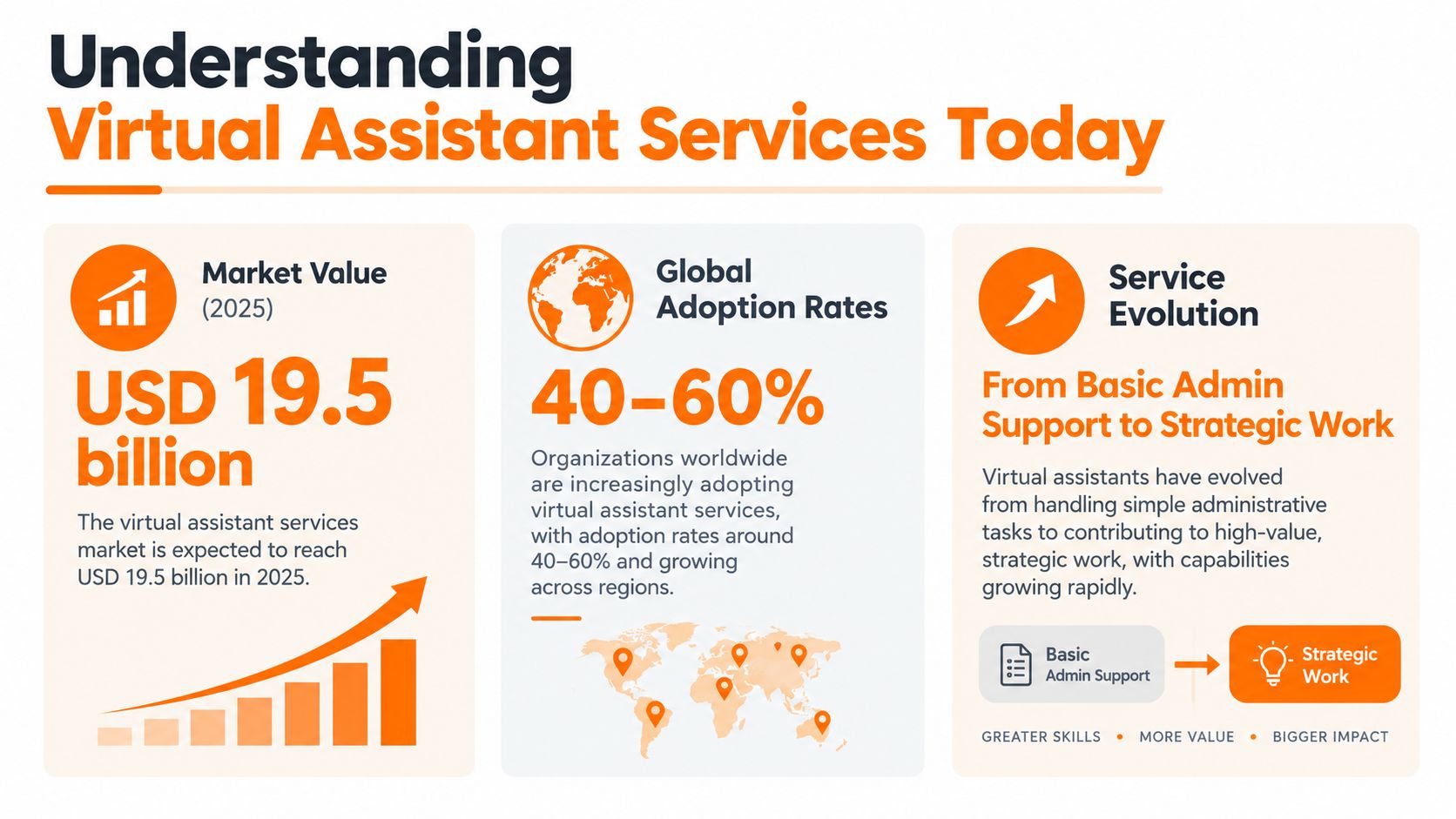
From delegated tasks to operating capacity
Traditional VA work covered email, scheduling, data entry, travel planning, and basic customer support. Current services can also include bookkeeping, lead research, SEO coordination, content operations, social media management, design production, and technical administration. A business may purchase an individual's time, managed team coverage, or automated execution.
That range makes task definition the first buying decision. A founder handling sensitive customer escalations needs discretion and a clear human review point, not just the lowest hourly rate. Recurring formatting, queue maintenance, and other rule-based work may be better handled by software, provided the output is easy to check and reverse.
A second tracker using a narrower definition puts the market at USD 4.2 billion in 2020 and USD 17.1 billion in 2025, with its USD 19.6 billion 2026 figure identified as a projection. The two series are not directly comparable. The first uses a broader market estimate, while the second captures a narrower category, so the ranges are useful for planning rather than precise reporting. (Stealth Agents)
The operating shift is clear even when the boundaries are not. Cloud collaboration, online payments, asynchronous communication, and AI tools have widened remote administrative work into digitally delivered business support.
Founder's rule: Buy relief from a bottleneck, not a vague promise of “support.”
What the service actually includes
A useful service brief defines an outcome, its inputs, and its approval rule. “Manage social media” leaves too much room for interpretation. “Prepare platform-specific drafts from approved source material, place them in a review queue, and maintain the publishing calendar” gives a person or system work that can be tested.
Virtual assistant services commonly cover:
- Administrative operations: Calendar maintenance, inbox triage, meeting preparation, file organization, and recurring coordination.
- Customer and sales support: Inbox responses, lead qualification, follow-up, CRM updates, and escalation routing.
- Content operations: Research, briefs, proofreading, repurposing, formatting, newsletter preparation, and publishing coordination.
- Growth support: SEO research, competitor monitoring, outreach preparation, social media scheduling, and campaign administration.
- Specialist execution: Bookkeeping, design, development support, data analysis, recruiting, and project management.
The hybrid model assigns each task according to risk and context. Clear inputs, repeatable rules, and reversible outputs suit autonomous automation. Work involving confidential information, customer relationships, brand judgment, or irreversible decisions should remain with a person or require a human approval gate. Measure the automated layer through error rates, exception volume, and turnaround time. Measure the human layer through judgment, resolution quality, and whether escalations reach the right person.
Types of Virtual Assistant Models to Consider
The three main models differ less by job title than by where judgment lives. A human assistant carries context in experience and conversation. An agency adds management, coverage, and replacement processes. An AI agent applies rules and learned patterns at software speed. A hybrid model assigns each layer deliberately.
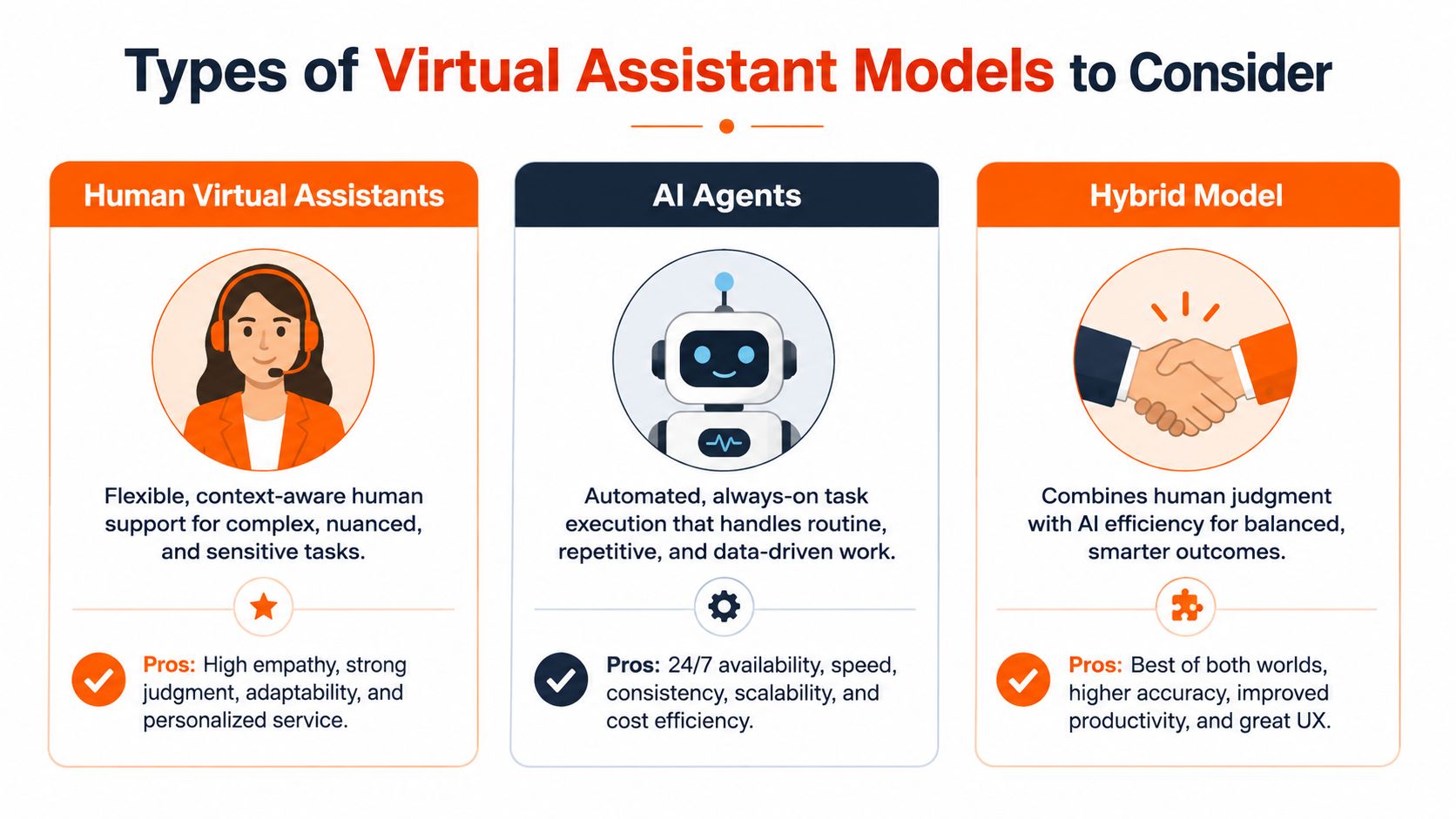
Human virtual assistants
A direct-hire or freelance VA works well when the business needs a consistent person who can learn preferences, notice exceptions, and communicate with customers or colleagues. Human support is particularly valuable when instructions are incomplete but the desired outcome is clear.
For example, “protect my afternoon for focused work” requires more than moving meetings. The assistant needs to understand priorities, recognize sensitive relationships, and ask when trade-offs are unclear. The same applies to a frustrated customer, an unusual vendor request, or a research assignment where source quality matters more than speed.
The limitations are practical. A person needs onboarding, feedback, availability planning, and a secure access setup. Capacity can become a constraint, and the quality of work may vary if the brief is vague or the assistant supports too many clients.
Agency-managed teams
An agency model adds structure around the individual contributor. The agency may source candidates, manage contracts, coordinate payroll, provide account oversight, and arrange replacement coverage. This can suit a growing business that needs several capabilities but doesn't want to manage separate contractors.
The trade-off is distance from the operator doing the work. You may gain process and continuity while losing some direct control over selection, communication, or day-to-day prioritization. Ask who owns quality, how substitutions work, how quickly issues are escalated, and whether the proposed assistant is dedicated or shared.
AI-powered assistants
AI assistants excel when a workflow has repeatable rules, stable inputs, and outputs that can be checked or reversed. Drafting social copy from approved material, reformatting content for different networks, classifying inbox messages, preparing summaries, and maintaining queues are natural starting points.
AI doesn't remove operating responsibility. Someone still has to define the policy, connect the right systems, monitor errors, and decide what requires approval. An automated system can repeat a mistake faster than a human, particularly when it has broad access and no meaningful stop condition.
A comparison that starts with the work
| Decision criterion | Human VA | Agency model | AI assistant |
|---|---|---|---|
| Ambiguous requests | Strong | Depends on assigned staff | Weak without clear rules |
| Relationship-sensitive communication | Strong | Strong with the right operator | Usually requires review |
| Repetitive formatting | Capable, but manual | Capable, with process overhead | Strong |
| Continuous queue maintenance | Limited by availability | Better coverage | Strong |
| Confidential or high-impact actions | Review and judgment | Managed review | Approval gate required |
| Setup and management | Directly owned by you | Partly outsourced | Requires workflow design |
A hybrid model often wins because it separates execution speed from accountability. AI handles predictable production, while a human owns exceptions, approvals, and the quality standard. The model isn't automatically cheaper or simpler. It becomes useful when the workflow has enough recurring volume to justify automation and enough nuance to justify human control.
Human Virtual Assistants Versus AI Agents
A task list doesn't answer the buying question. “Email management” could mean sorting messages by rules, writing routine replies, handling a delicate complaint, or deciding which opportunity deserves the founder's attention. Those are different jobs, even though they share a label.
The better comparison uses five tests: ambiguity, sensitivity, relationship value, exception frequency, and reversibility.
Give AI the predictable layer
AI is a sensible first operator when the task has a defined input, an explicit policy, and a low-cost correction path. A system can draft a post from approved source material, format it for multiple channels, place it into a queue, and flag missing information. It can also prepare a recurring report or categorize incoming requests before a person reviews them.
The quality measure should match the task. For formatting, inspect structural accuracy and whether the output meets channel requirements. For classification, measure routing accuracy and the number of items incorrectly escalated or missed. For drafts, measure factual correctness, brand fit, edit distance, and approval frequency.
AI is poorly suited to deciding what your company should say when the facts are incomplete or the emotional stakes are high. It can produce fluent language without understanding the commercial or relational consequences.
Keep judgment with a person
Human VAs remain valuable when the work depends on tacit knowledge. A person can ask a clarifying question, notice that a customer is asking for an exception, recognize a reputational risk, or adapt communication to a relationship that the system doesn't understand.
That doesn't mean every human action needs manual supervision. Give the assistant authority over defined, reversible tasks, then reserve founder or manager review for decisions involving pricing, legal commitments, sensitive data, public claims, permission changes, or unusual audiences.
Practical rule: If an error would be embarrassing but easy to correct, automate with monitoring. If it would damage trust, expose data, or create an obligation, require a human gate.
Evidence from a healthcare decision study illustrates the logic behind targeted review. Physician-only accuracy was 80.8%, AI-only accuracy was 84.7%, and a deferral workflow combining AI with human review reached 86.9%. The same source describes a screening example that reduced false positives by 25% at the same false-negative rate while cutting clinician workload by 66%. Healthcare isn't a direct business analogy, but the workflow principle transfers: automate routine decisions and route uncertain or consequential cases to people. (Stealth Agents on human-in-the-loop AI)
Build the gate into the workflow
A practical social content workflow might look like this:
- AI drafts: It uses approved brand material and creates channel-specific versions.
- Automated checks run: The system flags unsupported claims, prohibited topics, missing links, and unusual targeting.
- Human review begins: A VA checks tone, context, visuals, and audience fit.
- Approval determines execution: Routine approved content can publish automatically, while flagged content returns for edits.
- Performance informs the next cycle: The team reviews quality and audience response, then updates the brief.
A founder shouldn't need to inspect every comma. The founder should be able to inspect the policy, the exceptions, and the audit trail.
For a practical view of how AI assistants can support marketing production without eliminating review, see maximizing marketing productivity with AI assistants. The key is not to let “autonomous” become a synonym for “unsupervised.”
How Virtustant Can Help
Some founders don't need a task marketplace. They need a person who can work in overlapping hours, communicate comfortably in English, and stay accountable after placement. Virtustant operates as a remote staffing agency connecting U.S. companies with professionals across Latin America for full-time remote roles.
Its model combines sourcing, assessment, placement, contracts, payroll, HR, compliance, and account management. The service covers virtual assistants, executive assistants, customer support, sales development, bookkeeping, marketing, design, development, project management, data analysis, and recruiting.
The process is designed for businesses that want a managed nearshore hire rather than a one-off freelancer. Virtustant describes a shortlist delivered within 48 hours, typically with three to five pre-vetted candidates, and a four-stage vetting process covering English, cognitive ability, role-specific skills, and experience or references. Pricing starts at $7 per hour on an all-in basis, with no recruitment, setup, or placement fees, according to the provided company information.
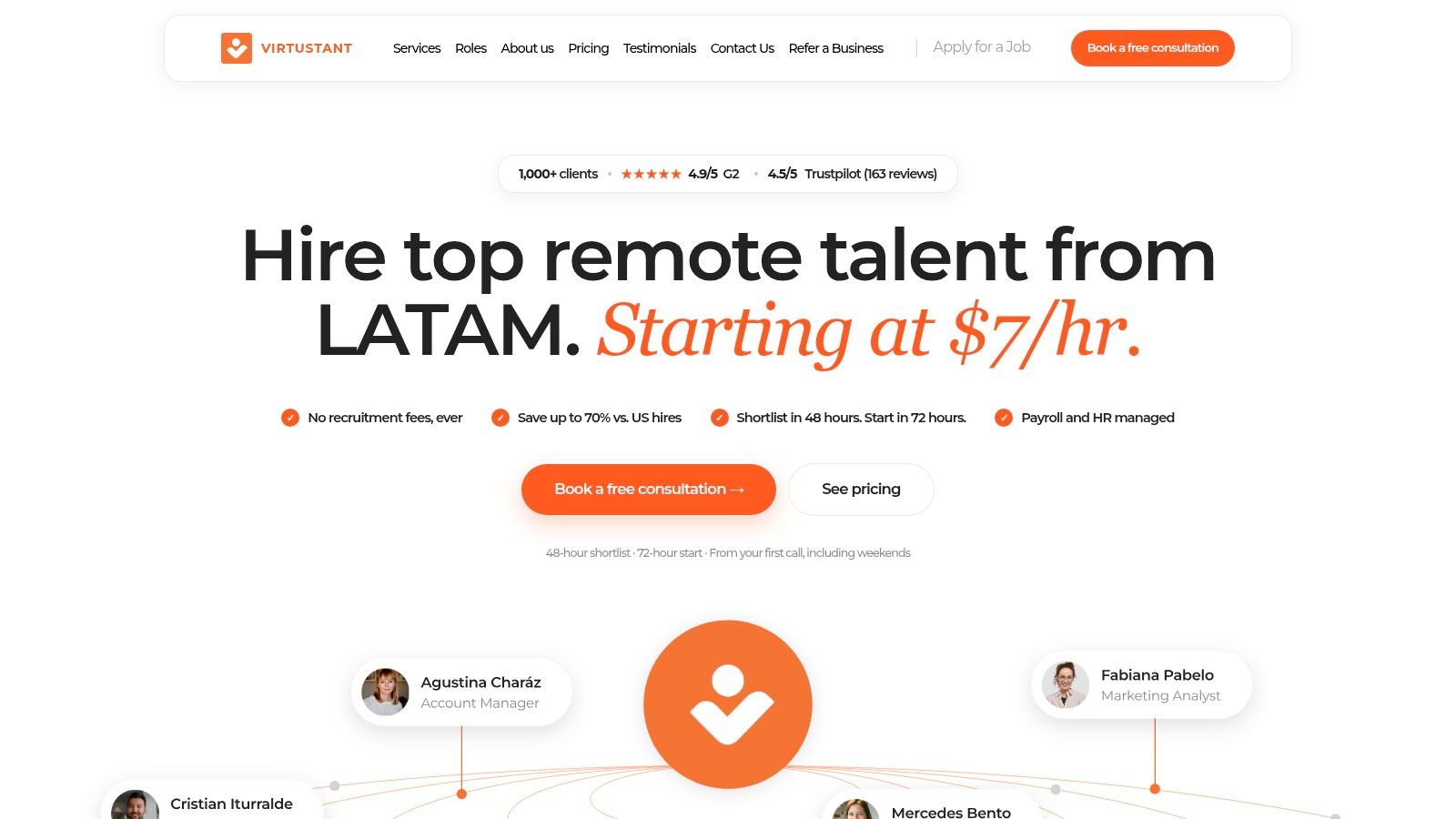
The fit is strongest when you need same-day collaboration, a dedicated operator, and less cross-border administration. Nearshore coverage can simplify meetings and feedback loops, while the provider handles local contracts and payroll. A lifetime replacement guarantee can also reduce the disruption of attrition.
Before signing, define the work in outputs, not labels. Give the candidate a sample queue, specify which actions require approval, document the tools involved, and decide how performance will be reviewed. If you're comparing managed nearshore staffing with other virtual assistant services, evaluate the operating burden as carefully as the hourly rate.
Security, Access Control, and Onboarding Best Practices
Remote support isn't unsafe by nature. Poor access design is unsafe. Shared passwords, excessive permissions, unapproved applications, and accounts that remain active after someone leaves create avoidable exposure, especially when an assistant handles customer records, financial information, content systems, or social profiles.
NIST guidance describes modified cybersecurity and privacy risks from AI, including the possibility that predictive analytics can intensify behavioral tracking and reveal sensitive information. The same principle applies to a human or AI assistant: treat the assistant as an identity-bearing execution path, not as a harmless interface. (NIST-related virtual assistant guidance)
Start with a permission map
Before onboarding, list each system, the required operation, the data visible there, and the person responsible for approval. Don't give a VA an administrator account because it feels quicker.
- Use individual accounts: Every operator should have a named identity, multifactor authentication, and a password-manager workflow.
- Limit by operation: Someone who drafts social posts doesn't need permission to change account ownership or billing.
- Separate environments: Use test or draft areas where possible, then give production publishing access only to approved roles.
- Define data boundaries: State what may be viewed, downloaded, copied, or moved into another tool.
- Log sensitive activity: Retain records for publishing, deletion, permission changes, exports, and external communications.
Tokens and credentials should be encrypted in transit, rotated periodically, and revocable immediately. Avoid placing a shared administrator token inside a spreadsheet or chat thread. If an AI tool connects to a customer system, scope the connection to the minimum profiles and actions required.
Access should be granted per person, service, and operation. “They need access to the CRM” is not a permission policy.
Separate recommendation from execution
The safest default is draft first, execute second. An assistant can prepare an email, schedule a post, suggest a record change, or assemble a payment request without having unrestricted authority to complete the action.
Use explicit approval for publishing sensitive claims, deleting records, changing permissions, sending external communications, and handling unusual customer requests. The review screen should show the source context, intended action, detected risks, and the approving identity.
Onboarding should make those rules visible:
- Document the workflow: Include inputs, outputs, deadlines, escalation paths, and examples of acceptable work.
- Issue scoped access: Grant only the systems and operations needed for the first assignment.
- Run a supervised task: Review the work before expanding permissions.
- Create a recurring access review: Remove unused access when responsibilities change.
- Prepare offboarding before day one: List accounts, sessions, tokens, devices, shared folders, and integrations that must be revoked.
For a product-specific onboarding perspective, onboarding guide to Quuu Automate demonstrates why setup should include profile connections, brand information, review preferences, and publishing controls rather than only a login.
Make offboarding immediate
When a role ends, revoke credentials, sessions, tokens, shared-folder access, and application connections. Retrieve company devices where relevant, confirm deletion or return of exported data, and review audit logs for recent sensitive actions.
Agencies and staffing providers should make this process contractually clear. Cross-border work adds administrative complexity, but it doesn't change the core rule: access belongs to the business, and the business must be able to remove it without waiting for a former operator to respond.
Cost, Pricing Models, and Return on Investment
A low hourly rate can become expensive when the founder spends hours clarifying tasks, correcting errors, chasing updates, and rebuilding work. Compare total operating cost, not just the figure on a rate card.
Pricing usually follows the delivery model. A human VA may charge by the hour or through a recurring commitment. An agency may bundle coverage, management, and replacement processes. An AI platform may charge by profile, seat, or subscription. Each option moves costs into different areas, so assess setup effort, supervision, reliability, and exit flexibility alongside the direct fee.
Calculate the work before calculating the price
Start with a workload ledger. Record each task, its frequency, average handling time, required judgment, error impact, and current owner. Then place every task in one of three operating layers:
| Work layer | Suitable owner | Main cost to track |
|---|---|---|
| Repeatable execution | AI or documented VA process | Subscription, setup, and exception handling |
| Reviewed production | AI plus human gate | Draft review, corrections, and approval time |
| Relationship or judgment work | Human VA or founder | Labor, context transfer, and continuity |
This division makes the hybrid model measurable. AI can handle repeatable production, while human gates protect brand-sensitive, customer-facing, or high-risk decisions. A VA can supervise exceptions without manually performing every routine action.
Value may come from reclaimed founder time, less repetitive work, more consistent publishing, and fewer costly mistakes. Count those benefits against a baseline rather than treating activity as return.
Track time reclaimed, accepted outputs, revision volume, missed deadlines, escalations, and errors by severity. For social content, separate generated posts from posts that passed review and posts that met the existing business objective. For customer support, measure correct routing and resolution quality, not response volume alone.
Market forecasts also require careful comparison. One estimate places 2025 revenue at USD 19.5 billion, while Grand View Research places it at USD 23.11 billion and projects USD 231.03 billion by 2035. The difference shows how definitions, methods, and assumptions shape forecasts. Treat market sizing as context, not as a substitute for your own cost records.
Why hybrid usually beats a false choice
Assigning every repetitive action to a person wastes human judgment. Automating every customer-facing or brand-sensitive action increases quality and trust risk. A hybrid model gives repeatable production to automation and keeps exceptions with someone who understands the business.
Your internal numbers determine whether the model works. If an AI workflow produces drafts that take longer to correct than manual work would take, change the workflow or remove that task from automation. If a VA spends most of the day copying approved content between tools, automation may be justified. If approvals delay publication, redesign the queue before adding more software.
A sound pricing model makes oversight visible. Include onboarding, prompt or policy maintenance, review time, access administration, quality checks, and founder opportunity cost. The guide to pricing models for social services provides a useful framework for comparing recurring service structures, but the final decision should come from your workload ledger and quality records.
Implementing the Hybrid Model with AI Agents Like Quuu
A workable hybrid system doesn't begin with “turn on autopilot.” It begins with a controlled workflow and a clear boundary between production and approval.
For social media, the production layer can include idea generation, post drafting, visual preparation, network-specific formatting, scheduling, and queue maintenance. The human layer handles brand-sensitive claims, unusual topics, audience targeting, factual checks, escalation decisions, and changes to the publishing policy.
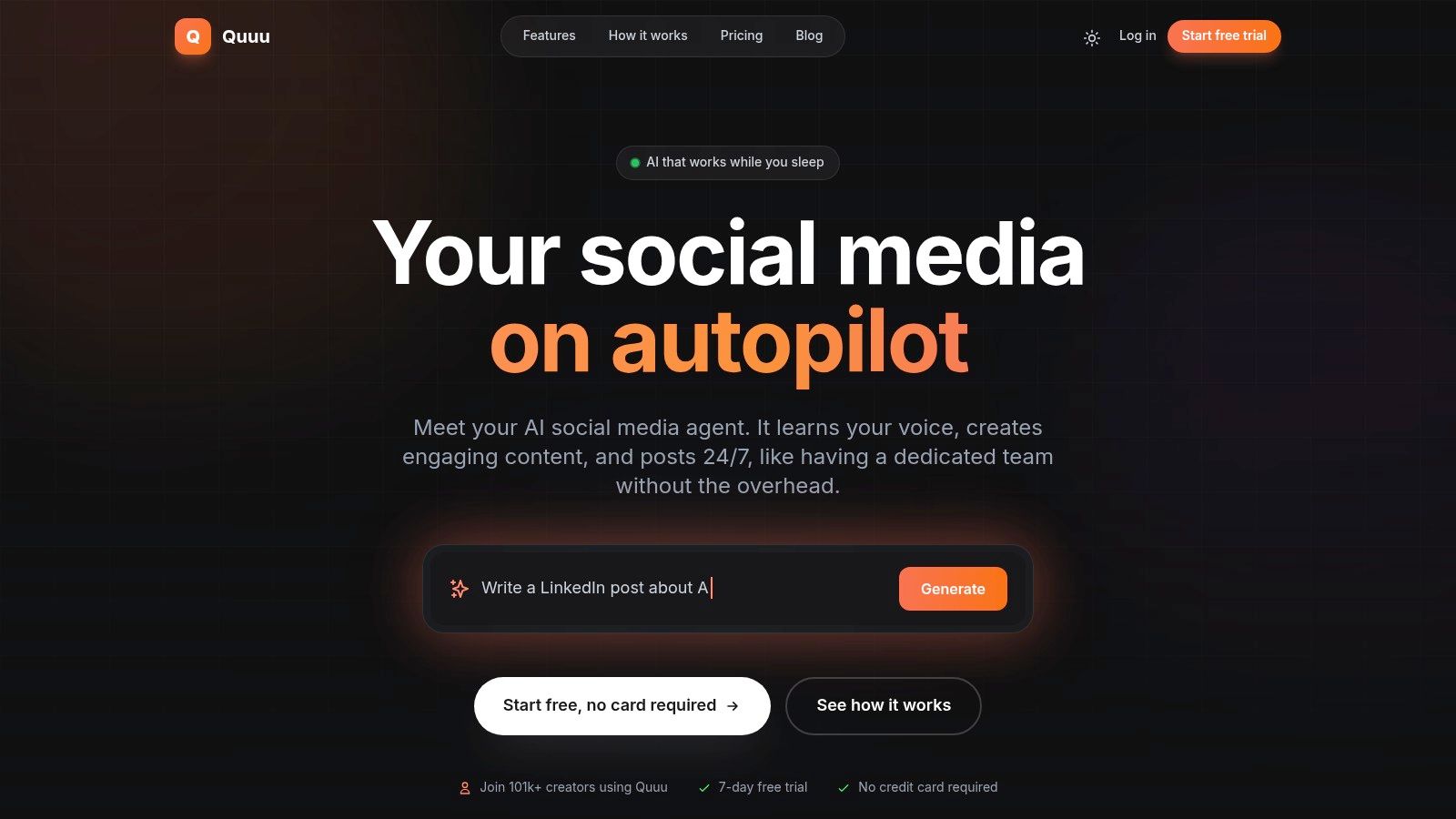
Quuu operates as a single AI agent spanning ideation, creation, scheduling, and publishing end to end. It learns brand voice from past posts, generates network-specific content, schedules based on audience activity, and maintains continuous automated queues. Built by Quuu Limited since 2015, it has evolved from curated content into an AI agent with data encryption, revocable tokens, and GDPR-friendly practices.
Design the operating loop
Begin with the source material. Gather approved website pages, product descriptions, previous posts, customer language, prohibited claims, preferred calls to action, and examples of writing that sounds wrong. The goal isn't to create a perfect prompt. It's to give the system a usable policy and a clear reference set.
Then divide content into lanes:
- Autonomous lane: Routine repurposing, evergreen reminders, formatting, queue maintenance, and low-risk drafts.
- Review lane: New product messaging, claims about results, customer stories, sensitive topics, and posts that mention partners or competitors.
- Human-owned lane: Crisis communication, public corrections, legal or regulatory statements, private customer matters, and strategic positioning.
Connect only the profiles and permissions required for the selected lanes. If the system can draft but not publish, the human gate remains meaningful. If it can publish routine content, define exactly what qualifies as routine and how to stop the queue.
A VA can operate the review lane without becoming a manual publishing bottleneck. The assistant checks source accuracy, removes unsupported statements, verifies links, reviews visuals, and escalates anything outside the policy. The founder reviews only the decisions that require business judgment.
Measure quality at each layer
Don't use one broad metric called “social media performance.” Measure the workflow itself:
- Production quality: Percentage of drafts that follow the brief, use the correct format, and require only light edits.
- Review quality: Number and severity of issues caught before publication.
- Execution reliability: Whether approved items publish correctly and whether queues remain current.
- Brand consistency: Whether language, positioning, and visual choices remain within the documented standard.
- Learning quality: Whether analytics lead to specific changes in topics, formats, timing, or approvals.
A high approval rate can be misleading if reviewers approve weak content too quickly. A low approval rate may indicate poor source material or an unclear brand policy rather than poor AI output. Review a sample of published work against the original source and intended audience, not just against whether the item left the queue.
This workflow also needs an interruption mechanism. Pause automation when a product changes, a public issue emerges, account permissions change, or a factual correction is required. The person responsible for the queue should know how to stop publishing without contacting a vendor or searching through old messages.
The goal isn't maximum autonomy. It's reliable autonomy inside a boundary your team can explain, audit, and reverse.
Use the system for throughput, the VA for context and quality control, and the founder for decisions that affect positioning or trust. That division lets a lean team maintain a consistent presence without pretending that every communication deserves the same level of automation.
The best implementation is usually incremental. Start with one workflow, establish the approval rules, record baseline quality, and expand only after the system behaves predictably. Virtual assistant services become a genuine operating advantage when the business can answer three questions at any moment: what ran, who approved it, and what happens when the system is uncertain?
Map your recurring work into autonomous, reviewed, and human-owned lanes this week. Choose one low-risk workflow, document its permissions and quality checks, then interview a suitable human VA or managed provider to own the exceptions. That small pilot will tell you far more than another generic service list.