Local SEO Platform Guide: Features, Benefits, and Setup
Discover what a local SEO platform does, from listing management to review tracking. Learn how to choose one and set it up for better visibility.

A customer searches for “emergency plumber near me” from a phone. One competitor appears in Maps with current hours, recent reviews, clear directions, and a helpful service page. Your business is only a few streets away, but the phone number differs across directories, one location page is outdated, and nobody noticed a new review. You may still be the better provider, yet the customer never reaches your website or calls.
That gap is why a local SEO platform should be treated as an operating system for local visibility, not a directory-cleanup subscription. It connects business data, maps, websites, reviews, rankings, and increasingly AI-generated answers, then gives your team a way to act on what it finds.
Table of Contents
- What Is a Local SEO Platform?
- Core Features That Define a Modern Tool
- Why the Definition Matters for Your Business
- How Synup Can Help
- Real-World Applications for Small Teams and Agencies
- How to Choose and Implement the Right Platform
- Measuring Success and Answering Common Questions
What Is a Local SEO Platform?
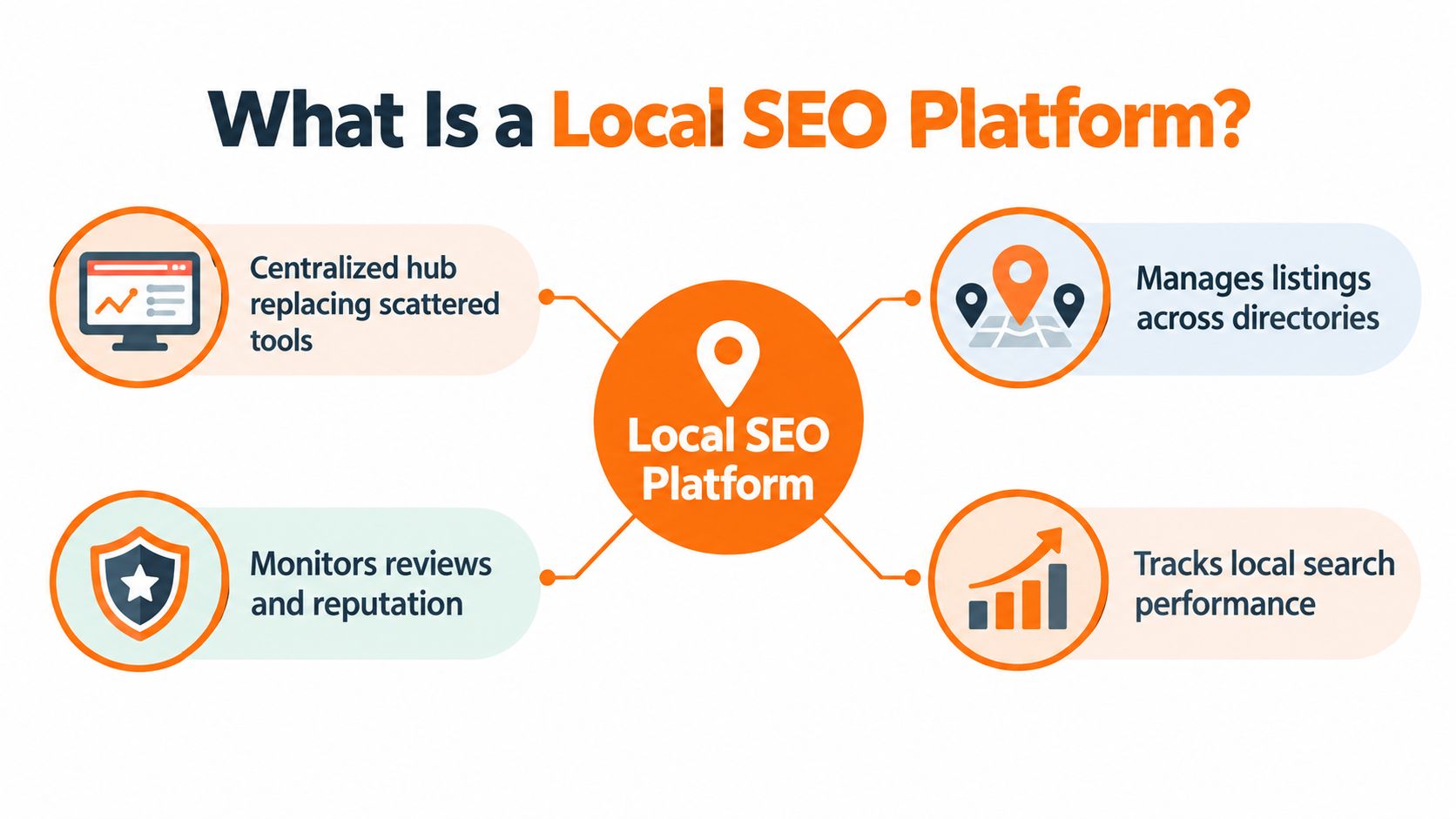
A local SEO platform is a centralized system for managing the digital signals that help nearby customers discover and choose a business. Those signals include Google Business Profile data, directory listings, citations, reviews, location pages, local rankings, structured data, and performance reporting.
The distinction matters because these elements affect one another. A wrong phone number on a directory can create friction for a customer. A weak business category can reduce relevance for a valuable query. A location page without accurate hours or directions may rank but fail to convert the visitor. A review workflow that sits outside your listing and reporting tools can leave important customer feedback unanswered.
Local search has become a major discovery channel. A widely cited compilation of local search data reports that 46% of all Google searches have local intent, 80% of U.S. consumers search for a local business online at least once a week, and 84% of local searches are for new businesses rather than brand names. The same compilation says 76% of “near me” mobile searches lead to a physical store visit within 24 hours. These figures describe a customer journey that often starts before someone knows your brand.
The operating model behind the software
A useful platform usually combines four jobs:
- Manage business entities: Store approved names, addresses, phone numbers, hours, categories, services, attributes, and location records in one controlled source.
- Distribute and audit information: Push accurate data to relevant directories and identify duplicates, missing fields, and conflicting records.
- Monitor customer signals: Collect reviews, alert teams to new feedback, and support response or review-request workflows.
- Measure local visibility: Track map results, local finder performance, organic location pages, calls, direction requests, and other actions by location.
The strongest systems don't just report that something is wrong. They connect the diagnosis to an action. If a location's category is too broad, the platform should help identify the correct category and route the change through an approval process. If a review arrives, the right person should receive an alert and a response draft rather than discovering it during a quarterly report.
What separates local SEO software from a general marketing suite
A general SEO suite may track keywords, backlinks, and technical website health. A social platform may schedule posts. A reputation tool may monitor reviews. A local SEO platform is distinct because it organizes those activities around physical locations and local entities.
That means it needs to understand the difference between a headquarters and a branch, a storefront and a service-area business, and one brand with many profiles. It should also show how visibility changes by searcher location instead of hiding local variation inside one citywide average.
For teams working across regions, localization practices for SEO are also relevant. A location page or profile shouldn't merely swap a city name into a template. Local language, customer expectations, service details, and cultural context can influence whether the page feels credible.
Practical rule: If a platform can't connect a location record to its listings, pages, reviews, rankings, and outcomes, you're looking at a collection of reports, not a local visibility system.
Core Features That Define a Modern Tool
Most platforms advertise broad coverage. The practical question is whether their features form a reliable workflow. A listing manager that can't show ranking movement is limited. A rank tracker that can't help correct inaccurate data only identifies problems. Review monitoring without ownership and approval controls creates another inbox.
A capable tool links the following layers:
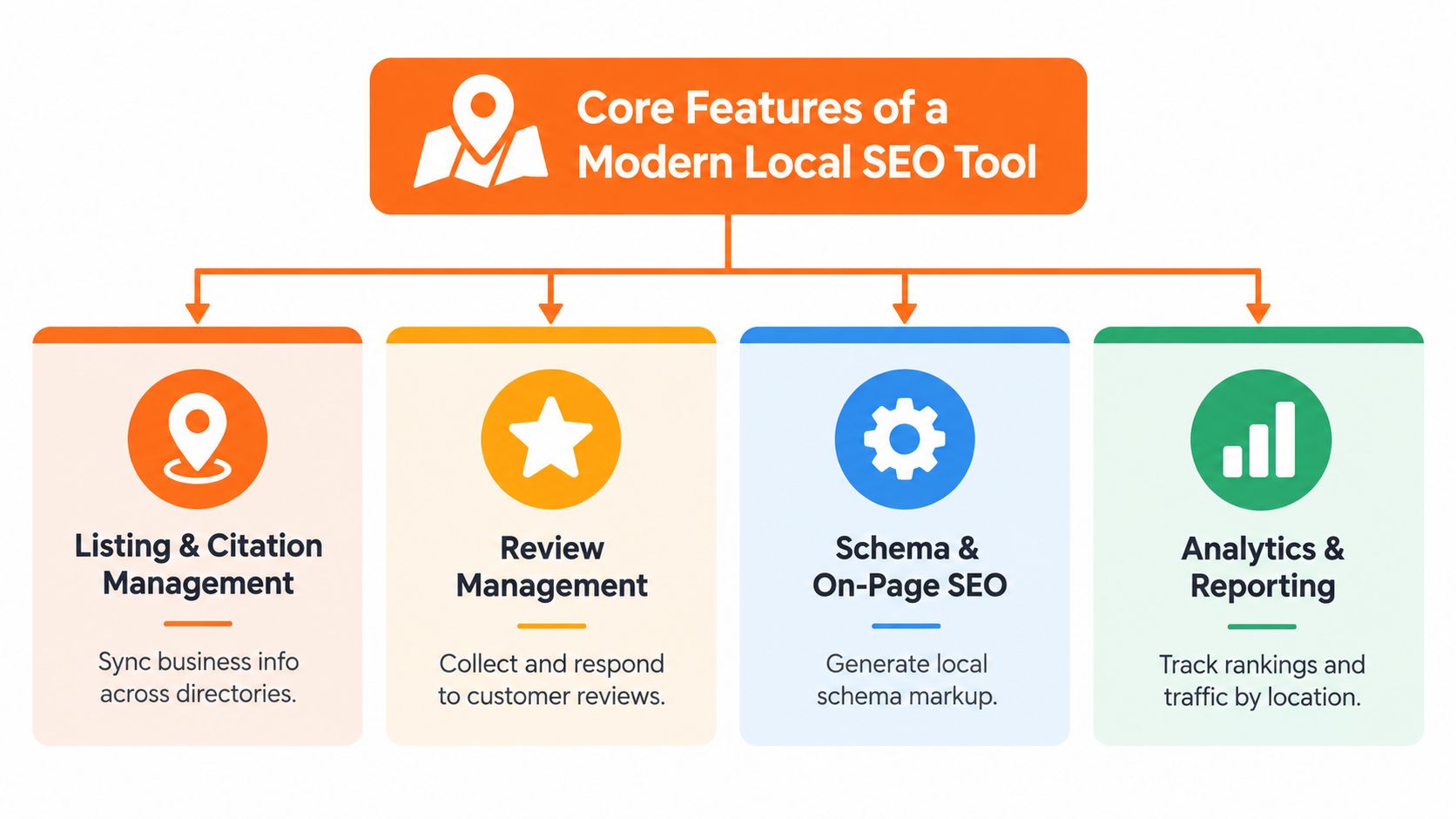
Listing and citation management
Your business information should have one approved source of truth. The platform then distributes or synchronizes that information across relevant publishers and checks whether the public records still match.
Look for:
- NAP controls: Consistent business name, address, and phone details.
- Duplicate detection: Identification of competing or obsolete profiles.
- Publisher coverage: Support for the maps, directories, social profiles, and industry sites that matter to your customers.
- Change alerts: Notifications when a publisher, user, or third party changes a listing.
- Bulk workflows: The ability to update many locations without editing each record individually.
Citation volume isn't the same as citation quality. A long list of irrelevant directories may create activity without improving discovery. Prioritize accurate, authoritative, and industry-relevant endpoints.
Category and profile optimization
Google's local results rely on proximity, relevance, and prominence, as explained in this overview of Google's local algorithm and ranking factors. A platform should therefore help teams improve the business category, services, attributes, description, hours, photos, and other profile fields that make the entity understandable.
Category selection deserves special attention. A study of 1.8 million Google Business Profiles reported that a specific primary category was associated with a roughly 36% higher presence in the top 10 results, with 12.5% versus 9.2% for the profiles studied. The same Google Business Profile category analysis found that strong secondary-category selection correlated with improvements of 6 to 17 ranking positions. These are associations, not guarantees, but they show why category modeling belongs in a serious audit.
Reviews and reputation workflows
Reviews influence customer confidence and provide context around the services and locations a business serves. A useful platform centralizes monitoring, assigns ownership, drafts responses, requests approval, and preserves a record of what was published.
It should also distinguish between review collection and review response. A message flow can make it easier for a recent customer to leave feedback, but it can't replace a good customer experience. Automated replies can save time, yet sensitive complaints still need human judgment.
Local rank tracking and entity analytics
A single rank number can hide large differences across a service area. Local tracking should show visibility by location, keyword, device or search surface where available, and competitor. Geo-grid views are especially useful because they reveal where a business appears near its premises and where coverage drops away.
Analytics should then move beyond rankings. Connect local visibility to:
- Calls and booked appointments
- Direction requests and contact actions
- Organic visits to location pages
- Review response activity
- Listing accuracy and profile completeness
- Store or branch performance
The local Map Pack data summary reports that businesses appearing in the Google Map Pack receive 126% more traffic and 93% more calls, clicks, and direction requests than businesses ranked 4 to 10. It also reports a 17.6% click-through rate for the number one Local Pack result. The lesson isn't to chase a position in isolation. It's to understand how local visibility connects to actions customers take.
Schema, location pages, and content complete the system. LocalBusiness markup can clarify entity details, while unique location pages give customers useful information about parking, services, access, and hours. If you're evaluating adjacent automation categories, this comparison of AI content curation platforms illustrates why feature breadth matters less than workflow fit.
Why the Definition Matters for Your Business
The outdated view says local SEO is mainly citation cleanup. Cleaning listings still matters, but it's only one layer of a much larger discovery system.
A customer may find a business through a Google result, a map application, a directory, a voice assistant, or an AI-generated answer. Each endpoint needs enough accurate, consistent information to identify the same real-world business. A platform that updates directories while ignoring location pages, entity verification, and AI visibility solves yesterday's problem.
Google's three local signals provide a practical framework:
- Proximity: Is the business close enough to the searcher or relevant service area?
- Relevance: Does the category, profile, website, and content match the query?
- Prominence: Does the business show credible authority through reviews, links, mentions, and broader recognition?
A platform can't rewrite geography. It can, however, help teams improve relevance through precise categories and complete profile data. It can support prominence by organizing review workflows, identifying citation gaps, and surfacing opportunities for credible local mentions. It can also help a brand keep its entity information consistent across the endpoints that feed search and AI systems.
The market is moving toward entity operations
Recent market research projects the local SEO software market to grow from USD 9.12 billion in 2025 to USD 10.34 billion in 2026, then reach USD 19.36 billion by 2031. The market outlook identifies AI entity verification and real-time location data as emerging drivers.
That direction changes the buying criteria. You shouldn't ask only whether a tool can correct a listing. Ask whether it can maintain a trusted location record, distribute updates quickly, identify conflicting information, and show how your business is represented in AI answers.
What a narrow tool misses
A listings-only product may fix your address but fail to tell you that:
- Your strongest service page doesn't mention the location clearly.
- A competitor has chosen a more specific category.
- Reviews are arriving faster than your team can answer them.
- Map visibility is strong near one branch but weak across the wider service area.
- AI systems cite outdated or incomplete business information.
- Store-level outcomes aren't separated from brand-level traffic.
This doesn't mean every business needs the largest possible platform. A one-location shop may need a focused listing and review workflow. A franchise or agency needs permissions, bulk editing, audits, location-level analytics, and repeatable governance.
The right definition prevents overbuying and underbuying. Buy for the discovery surfaces and operational problems you need to manage, not for a feature count that looks impressive in a sales presentation.
How Synup Can Help
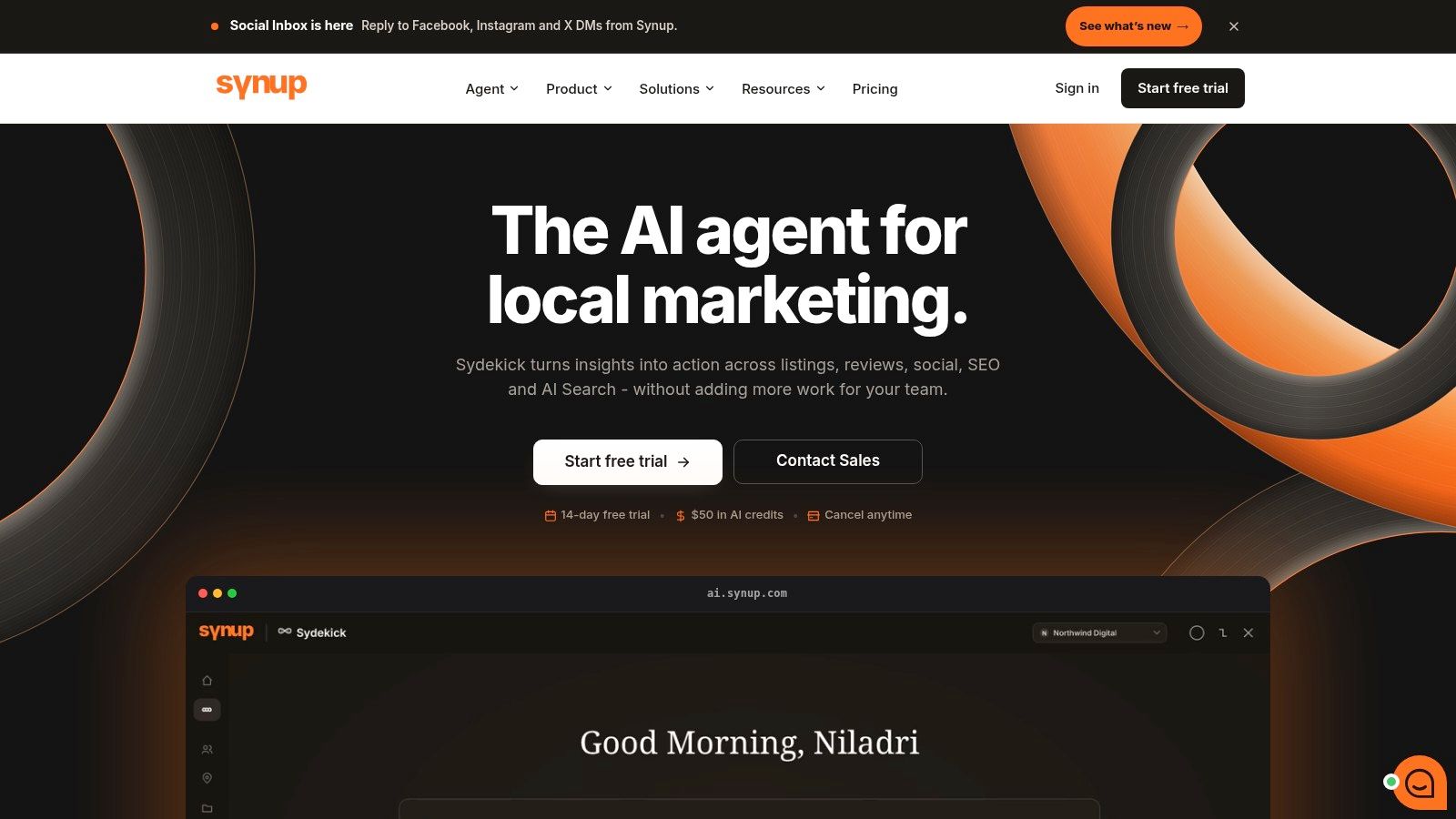
Synup is a local marketing, listings, and reputation management platform designed to bring location operations into one command center. Its capabilities cover listings, reviews, social publishing, local pages, rank tracking, reporting, and Answer Engine Optimization.
Its AI agent, Sydekick, can work through chat, memory, skills, playbooks, inference, approvals, and an audit trail. That combination matters because autonomous execution without governance is risky for location data. Teams can define what the agent may research, draft, or publish, then retain visibility into every proposed and completed action.
Where the platform fits
Synup syncs listings across Google Business Profile, Apple Business Connect, Bing, Facebook, and more than 100 publishers, with audits and autonomous corrections. It also monitors reviews, drafts responses, supports approval workflows, and runs review-generation campaigns using short links and message flows.
For a location team, the broader toolkit includes:
- Local social publishing with store-level voice and tone.
- Rank tracking for local pack visibility.
- Store locators and location pages on a custom domain.
- AEO diagnostics across ChatGPT, Gemini, and Perplexity.
- APIs, first-party MCP support, and model connectors.
- Branded reporting, white-label portals, and scoped permissions.
For a small business, the value is reducing repetitive updates and keeping reviews, listings, and pages aligned. For an agency, the differentiators are different: multi-client controls, a branded client experience, shared workflows, and the ability to operate many locations without building a separate spreadsheet system.
A practical evaluation should still test data accuracy, approvals, publisher coverage, reporting depth, and cancellation terms. If those requirements match your operating model, Synup is a useful platform to examine alongside more specialized rank trackers and listing tools.
Real-World Applications for Small Teams and Agencies
The same software can serve a coffee shop owner and a franchise agency, but they won't use it in the same way. The owner needs fewer manual tasks and clear alerts. The agency needs governance, scale, permissions, and reports that explain performance without requiring an analyst to rebuild the story every month.

For a single location
A local owner should begin with a complete business record. Confirm the official name, address, phone, opening hours, categories, services, website, and preferred review destination. Then connect the primary profiles and let the platform identify duplicates or mismatches before adding more automation.
A dental practice, for example, might prioritize:
- Review alerts: Route new feedback to the practice manager.
- Response approvals: Allow staff to draft replies while the owner approves sensitive cases.
- Location page accuracy: Keep services, parking, accessibility, booking options, and hours aligned.
- Call measurement: Separate calls from local profiles and organic pages where the analytics stack permits it.
- Monthly review: Compare visibility changes with calls, booked consultations, and customer feedback.
The owner shouldn't spend time publishing generic updates merely to make a dashboard look active. Every post, page change, and review request should support a real customer question or operational goal.
For agencies and multi-location brands
An agency managing many branches needs a different control layer. Establish naming conventions, owner permissions, approved categories, escalation rules, and a location data template before importing profiles. Bulk edits are valuable only when the underlying records are clean.
A franchise group could use the platform to:
- Audit branches: Find incorrect hours, phone numbers, categories, and duplicate records.
- Model categories: Compare primary and secondary category choices by market and service.
- Monitor reputation: Route reviews to the correct local team while preserving central oversight.
- Track geographic visibility: Identify branches that perform well near the address but poorly elsewhere.
- Report outcomes: Separate brand traffic from location-level calls, directions, bookings, and visits.
Buyers often ask whether a local SEO platform improves revenue. Recent coverage emphasizes rankings and reviews but gives less attention to proving incremental footfall, calls, or store visits across channels, as noted in this market analysis of local SEO software. Build measurement around those business actions from the start, even if some offline outcomes require point-of-sale, CRM, or call-tracking integrations.
Privacy and operating discipline
A platform may hold customer reviews, employee access details, location records, and messaging data. Check role permissions, approval logs, data retention, token revocation, encryption practices, and contractual responsibilities before connecting accounts. Agencies should also make sure clients can retrieve their data and understand what happens when a contract ends.
How to Choose and Implement the Right Platform
A good purchase begins with a failure analysis, not a feature checklist. Write down what currently breaks, who fixes it, how long the fix takes, and which customer action suffers when nobody notices.
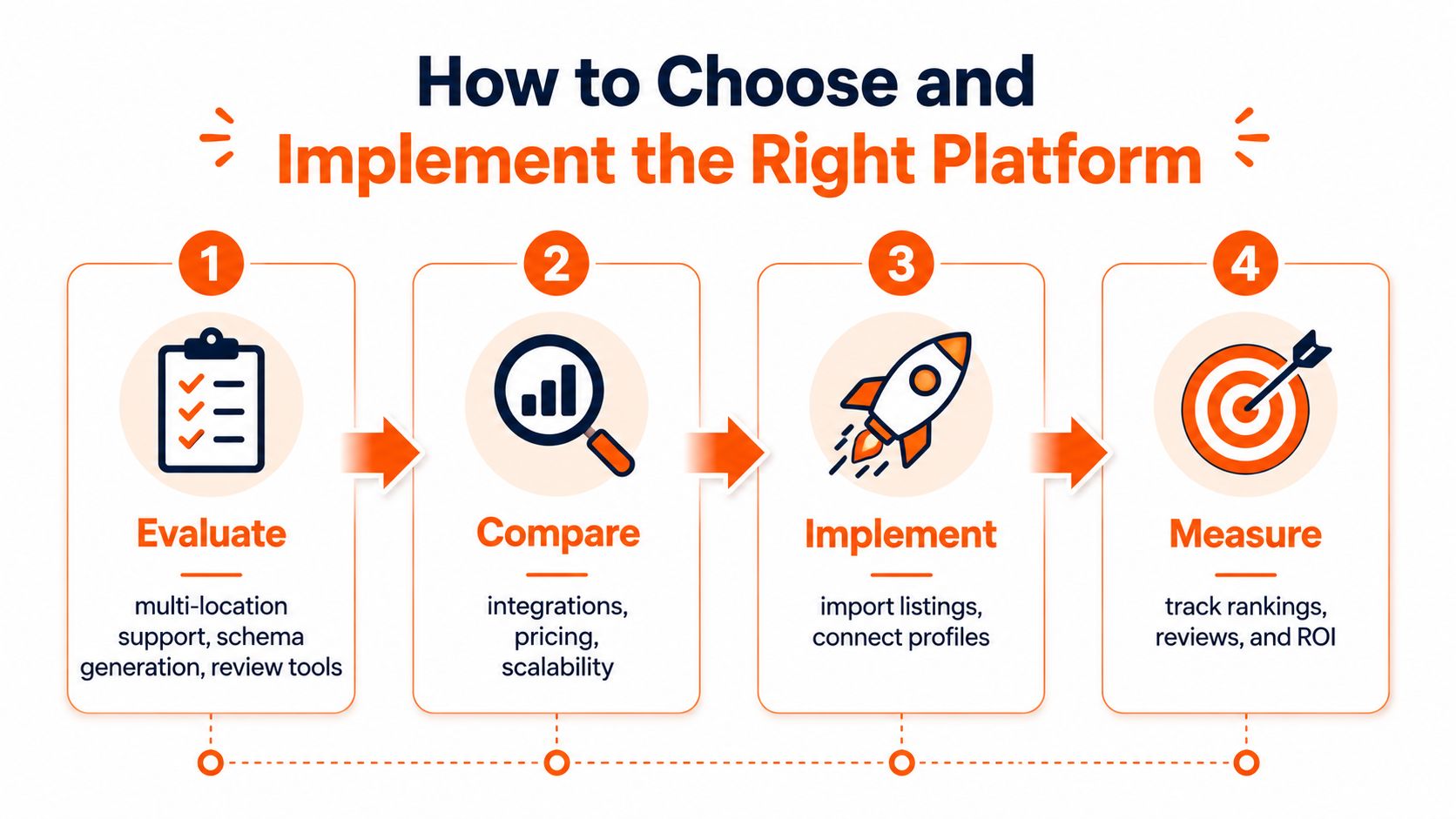
A platform should earn its place by improving execution and measurement. Use the following sequence:
Evaluate the operating requirements
Start with location count, business type, markets, and team structure. A single clinic may need profile accuracy, reviews, and local rank visibility. An agency may require bulk imports, multi-client workspaces, white-label reporting, APIs, and approvals.
Then inspect the data model. Can the platform store one canonical record per location? Can it distinguish a service-area business from a storefront? Can users lock sensitive fields while allowing local managers to update posts or photos?
The core capability test should cover:
- Listing distribution and auditing
- Duplicate and change detection
- Category and profile recommendations
- Review collection, monitoring, and response
- Location pages and schema support
- Geo-specific rank tracking
- Integration with analytics, CRM, call tracking, and reporting
- AI answer visibility, if that is part of your strategy
Compare workflows, not screenshots
Ask a vendor to demonstrate a real task. Import a location, change its holiday hours, route the update for approval, publish it to supported endpoints, and show the audit record. Then add a review, draft a response, reject it, and confirm what the local manager sees.
Pricing needs the same scrutiny. Clarify whether billing depends on locations, users, scans, publishers, agent throughput, API usage, or report volume. A low entry price can become expensive when every branch or geo-grid scan adds a separate charge.
Don't ignore integration quality. A platform that reports calls but can't connect to your CRM may still leave revenue attribution unresolved. A tool that exports rankings but not location identifiers can force analysts to reconcile spreadsheets manually.
For data protection, look for:
- Role-based access: Staff should see and edit only the locations they manage.
- Approval controls: Sensitive listing changes should require explicit sign-off.
- Audit history: Every automated or manual change should be traceable.
- Access removal: Revoking a former employee's access should be straightforward.
- Retention clarity: Understand how reviews, messages, and business data are stored.
- Privacy commitments: Review contractual terms before connecting customer-facing systems.
This guide to choosing an automation tool for your brand is also useful when comparing automation based on safeguards rather than convenience alone.
Implement in controlled stages
For a small business, begin with one location and a baseline audit. Fix canonical business data, connect the primary profiles, review the most important directories, and verify that the website's location page matches the approved record. Only then add recurring review, publishing, and reporting workflows.
For an agency, create a pilot group that represents different client types. Include a storefront, a service-area business, and a multi-branch account if those are part of your portfolio. Test imports, permissions, approvals, exception handling, and branded reporting before migrating every client.
Set a measurement baseline before making major changes. Record existing profile actions, calls, direction requests, organic local traffic, review response times, and booked outcomes where available. You don't need perfect attribution to learn, but you do need consistent definitions.
Measure operational and commercial value
Useful KPIs fall into three groups:
| KPI group | Examples | What it tells you |
|---|---|---|
| Visibility | Map presence, local finder visibility, location-page impressions | Whether discovery is expanding |
| Trust and accuracy | Listing conflicts, duplicate records, review response time | Whether customers and platforms receive reliable information |
| Business actions | Calls, directions, bookings, store visits, qualified leads | Whether visibility creates demand |
The platform should make those metrics easier to interpret, not bury them beneath a composite score. A ranking improvement that produces no calls may indicate poor intent, weak profile content, or a conversion problem on the website.
Measuring Success and Answering Common Questions
A local SEO program succeeds when it improves the customer actions that matter to the business. For a service company, that may be qualified calls and booked jobs. For a retailer, it may be direction requests, store visits, and location-level sales. For an agency, it may also include faster response times, fewer data errors, and more reliable client reporting.
Build a measurement chain
Start with the path a customer follows:
Discovery → profile engagement → website or call → appointment or visit → revenue
Assign a measurable signal to each stage. Local pack visibility and impressions describe discovery. Calls, website visits, directions, and booking clicks describe engagement. CRM records, call outcomes, point-of-sale data, or store-visit estimates help connect marketing activity to commercial results.
Don't treat every metric as equally reliable. A ranking report can show visibility, but it doesn't prove that a customer became a buyer. A review count can indicate reputation activity, but it doesn't establish incremental revenue. Use several signals together and document the limits of each.
Common questions from buyers
Does a local SEO platform replace an SEO agency?
Usually, no. A platform can automate distribution, monitoring, reporting, review workflows, and parts of optimization. It doesn't replace strategy, local content judgment, technical implementation, outreach, customer experience work, or decisions about which markets deserve investment.
A small business may manage the platform internally if its needs are straightforward. An agency becomes more valuable when the business has several locations, complex service areas, poor historical data, or limited staff capacity.
How long does it take to see ranking improvements?
There isn't a universal timetable. Results depend on the starting condition, competition, location, category, prominence signals, website quality, and the changes made. Correcting an obvious phone number or hour error can improve customer experience quickly, while building authority and stronger local relevance takes sustained work.
Use a baseline and review trends over a consistent reporting cycle. Avoid vendors that promise a fixed ranking outcome without examining your market and business model.
What should I measure first?
Start with the actions closest to revenue:
- Qualified calls: Separate genuine leads from wrong numbers and spam where possible.
- Bookings and forms: Connect profile and website actions to your CRM or booking system.
- Direction requests: Useful for businesses that depend on physical visits.
- Store or branch performance: Compare locations rather than hiding weak branches inside brand totals.
- Review response operations: Monitor whether staff can respond accurately and promptly.
- Listing accuracy: Track unresolved conflicts and duplicate records.
A visibility score can support diagnosis, but it shouldn't be the final business KPI.
What if two locations share the same address?
First determine whether they are truly distinct businesses with separate customer experiences, branding, signage, contact details, and eligibility for individual profiles. Don't create duplicate profiles just to occupy more search results. Coordinate the location records, categories, phone numbers, pages, and review destinations carefully, then follow the relevant publisher's rules.
If the businesses are departments within one operation, a single profile with clear services may be more appropriate than separate entities. Have a platform or consultant audit the structure before making changes that could trigger suspensions or confuse customers.
Should I automate review responses?
Automate monitoring and drafting, not judgment. A response assistant can save time for routine praise and common questions, but complaints involving safety, refunds, privacy, discrimination, or legal issues need a trained human. Set approval rules, maintain a brand voice, and never expose private customer information in a public reply.
Are AI answers a separate SEO channel?
They are a separate visibility surface with overlapping foundations. AI systems still need clear entity information, trustworthy sources, relevant pages, and consistent business details, but their answer formats and citation behavior differ from traditional rankings. Measure AI presence separately rather than folding it into a Google position report.
The practical standard is simple: your platform should help the business remain understandable wherever customers search, then show whether that visibility produces meaningful action.
Choose a local SEO platform by the problems it can solve repeatedly, not by the length of its feature list. Audit your locations, define the customer actions you need to measure, and test one real workflow before committing to a full rollout. If your team also needs consistent social publishing alongside local visibility work, explore Quuu to automate brand-aligned content creation, scheduling, approvals, and reporting across your social profiles.