Custom Loyalty App: A Practical Business Guide for 2026
Custom loyalty app guide for 2026: ROI, build vs buy, must-have features, costs, launch tactics, and metrics that prove incremental profit.
Most advice about a custom loyalty app starts with the wrong question. It asks which features to build, which framework to choose, or how quickly the app can reach the stores. The better question is harder: what customer behavior must change, and can a downloadable app produce enough incremental profit to justify its cost?
Downloads aren't profit. A large member database isn't profit either. A loyalty program earns its keep only when it creates more profitable repeat behavior than the business would have received without it, after rewards, messaging, integration, maintenance, and compliance costs.
That distinction matters because mobile loyalty can increase engagement while also encouraging customers to wait for promotions or divide their spending across several brands. A custom loyalty app can be a powerful owned relationship layer, but it can also become an expensive discount dispenser. The recommendations below start with the economics, then work backward into format, technology, features, launch, and measurement.
Table of Contents
- Rethinking Whether You Need a Custom Loyalty App
- What a Custom Loyalty App Is
- The Business Case and ROI Reality
- Build vs Buy and the Hidden Costs
- How BonusQR Can Help
- Must-Have Features and Integrations
- Typical Costs and Tech Stacks
- Launch Playbook and Adoption Best Practices
- Real Examples and Metrics That Prove Profit
Rethinking Whether You Need a Custom Loyalty App
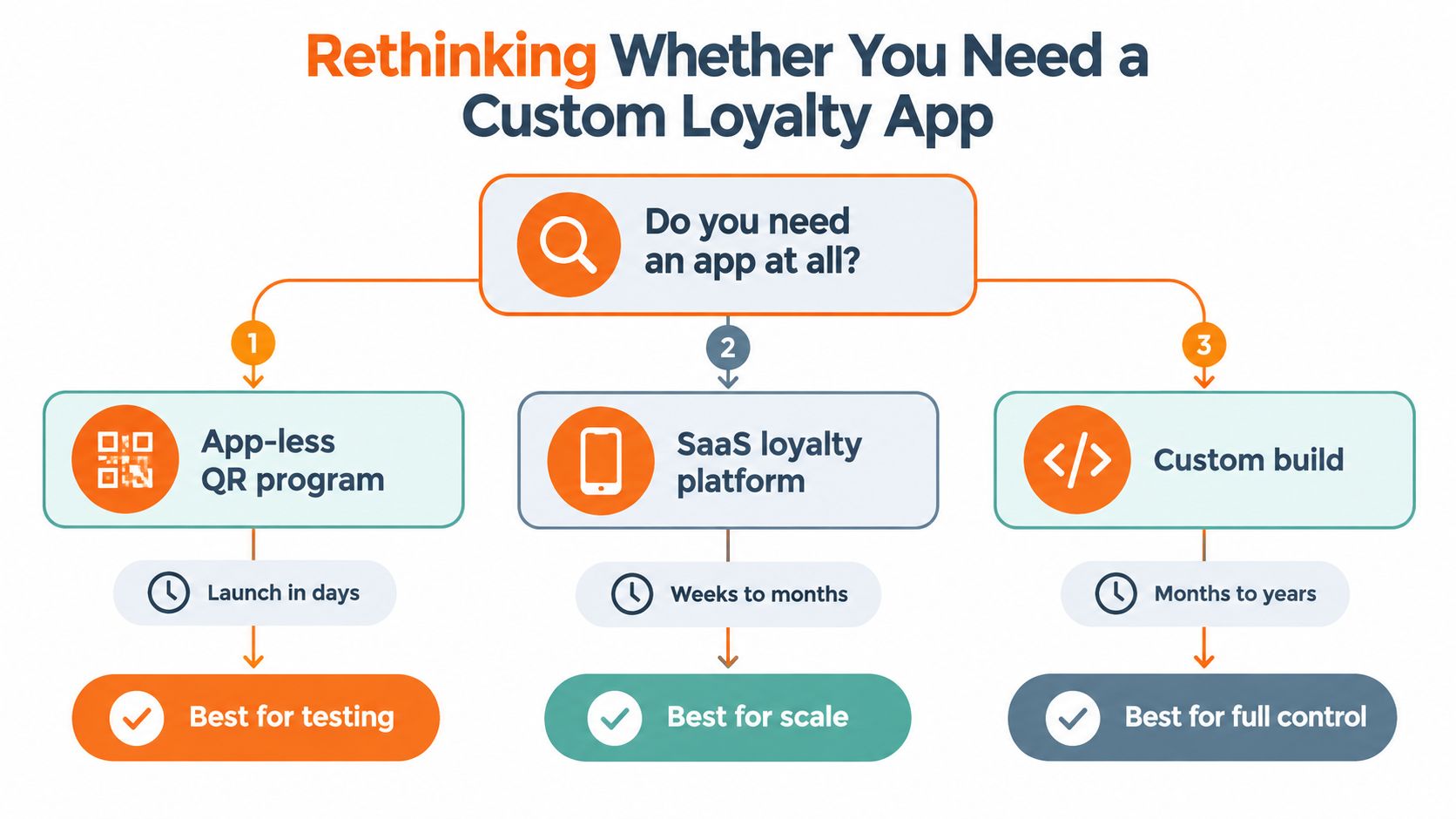
A native app isn't automatically the best loyalty experience. Customers don't care whether your program runs on custom code, a SaaS platform, a wallet pass, or a QR page. They care whether joining is easy, the reward is valuable, and redemption works when they're ready to buy.
Recent evidence supports that distinction. In 2025, 56% of consumers said they would download a loyalty app when the rewards were valuable, while 64% preferred apps over email for loyalty interactions, according to eMarketer's summary of loyalty research. Those figures show a value-driven preference, not a universal mandate to build a native app. The same source reports that more than 25% of operators with existing loyalty programs were interested in app-less alternatives, including QR codes, digital wallets, SMS, web accounts, and receipt-linked identifiers.
Start with the identity layer
Your first decision should be the lowest-friction way to identify a customer and let that customer earn or redeem value. A QR code may be enough for a local business whose customers visit occasionally. A wallet pass can keep a balance or offer available without requiring a full installation. SMS can work when reach matters more than rich interface design. A web account can remove App Store friction while still supporting an owned profile.
A native app earns its keep when your customer relationship depends on frequent interaction, complex reward logic, personalized content, location-aware prompts, or deep integration with ordering and payments. It also makes more sense when the brand can consistently give customers a reason to return to the app, not merely a reason to download it once.
Warning signs against a native build
Choose a lighter format first if:
- Visits are infrequent: Occasional visitors may not tolerate installation and account setup.
- The reward is simple: A basic stamp or threshold reward rarely needs a custom interface.
- Your data is fragmented: An app won't fix unreliable customer records or disconnected transaction systems.
- Staff can't promote it: A technically polished program will fail if employees don't know how to enroll and redeem members.
- The offer is unclear: Valuable technology can't rescue a reward customers don't understand.
Practical rule: Build the smallest identity and redemption layer that can test your economic hypothesis. Add native app complexity only after customer behavior justifies it.
A custom app becomes sensible when control itself creates value. That may mean owning a distinctive customer experience, connecting several brands or channels, supporting rules a packaged platform can't handle, or turning first-party behavior into timely service rather than blanket discounting. If the only reason to build is that competitors have an icon on the home screen, don't build yet.
What a Custom Loyalty App Is
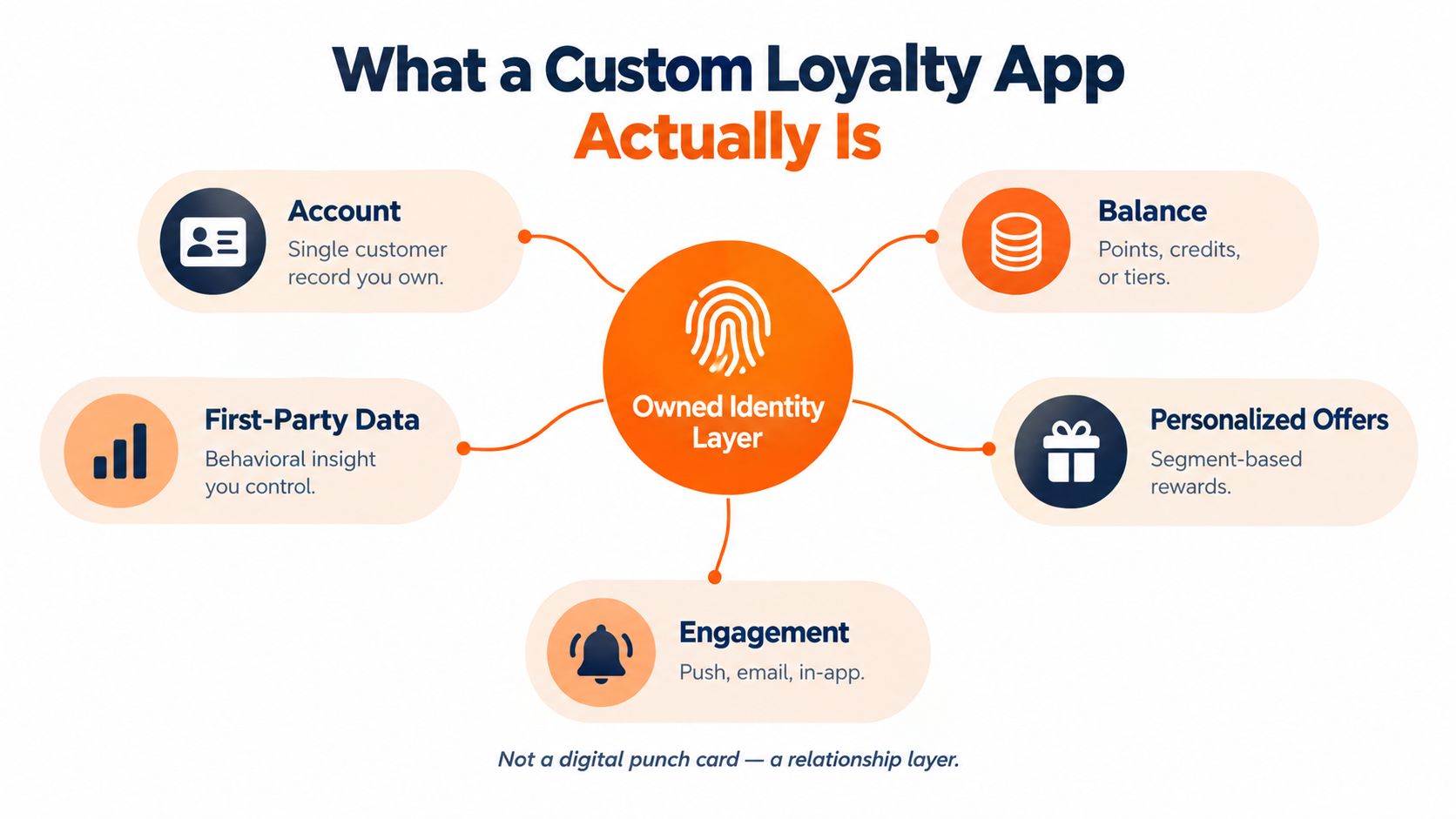
A custom loyalty app is an owned identity layer connecting a customer account with rewards, purchase activity, communications, and personalized experiences. Its value comes from making those interactions recognizable and measurable, not from placing a branded icon on a phone.
A coffee shop using paper cards illustrates the limitation. A customer buys a drink, receives a stamp, and eventually earns a reward. The business records a transaction, but the card may not show who made the purchase, how often that person visits, which products they choose, or whether the reward caused the next visit.
An app changes the unit of value. Customers sign in, earn points or credits, view a balance, receive relevant offers, and review their activity. The business can connect those actions to a permission-based profile, then decide what to communicate, when to send it, and which behavior to encourage.
The five connected parts
Account creates a persistent customer identity. It may use an email address, phone number, social sign-in, or another consented identifier. The business can recognize the person across relevant interactions instead of treating every order as anonymous.
Balance shows the value a customer has earned. Points are one option, alongside credits, stamps, visit counts, tiers, cashback, and tier-based rewards. Choose the mechanism that supports the behavior you want and remains easy for customers to understand.
Personalized offers turn transaction history into a reason to act. A customer who regularly buys one category could receive an offer connected to that interest, while a lapsed member could receive a carefully selected invitation to return. Personalization is not a different coupon for every person. It is a more relevant reward with a defensible cost.
Engagement handles communication. Push notifications, email, in-app messages, and wallet updates can remind customers about earned rewards, explain tier benefits, request feedback, or give them a timely reason to visit. Every channel requires permission, frequency controls, and a clear customer benefit.
First-party data gives the brand behavioral insight it can apply responsibly. The app can connect enrollment, purchases, redemptions, preferences, and responses into a clearer view of the relationship. Collection has strategic value only when it improves decisions.
Custom versus white-label
A white-label app usually provides a branded interface on an existing loyalty engine. A custom build gives the company greater control over the experience, data model, business rules, integrations, and release roadmap. That control also makes the team responsible for product decisions, testing, security, compliance, maintenance, and continued adoption.
The points are not the moat. The advantage comes from recognizing customers accurately, rewarding profitable behavior, and acting at the right moment. Design the app around the customer relationship you intend to manage, then measure whether it produces incremental profit. A feature list copied from another brand will not answer that question.
The Business Case and ROI Reality
A loyalty app can increase customer activity and still weaken profit. Mobile access creates a credible business case, but it does not justify custom development by itself.
A 2024 summary of Paytronix research reported that 57% of restaurants and 66% of convenience stores offered loyalty programs. National Restaurant Association data also found that 60% of loyalty members preferred accessing rewards through a mobile app, while 22% had no preference between an app and a physical card. These figures appear in eMarketer's overview of mobile loyalty behavior.
The stronger question is whether mobile access changes profitable behavior. A multinational restaurant study covering a company with approximately 18,000 locations across 15 brands compared smartphone rewards users with plastic-card users. App users spent more across the company and redeemed more points, according to the University of Notre Dame's discussion of the study.
The commercial warning matters. App users were also more likely to respond to deals, and their spending spread across several company brands rather than necessarily strengthening loyalty to one brand. Higher app sales can therefore accompany weaker brand concentration and lower margin.
Program Format vs Real Behavior
| Behavior | Plastic Card Users | Custom App Users |
|---|---|---|
| Access | Carry or present a physical identifier | Access rewards through a smartphone |
| Reward visibility | Limited to card or staff lookup | Balance, offers, and history can be visible in one interface |
| Transaction insight | More difficult to connect and activate | More usable for permission-based segmentation |
| Redemption | Often requires remembering or presenting the card | Can be surfaced and redeemed digitally |
| Commercial risk | Lower digital engagement potential | Greater exposure to promotion-sensitive behavior |
The correct ROI question is whether the program creates incremental contribution margin after rewards and operating costs, rather than merely increasing member spend. A customer who would have purchased anyway is not incremental. A member who buys only when a discount appears may raise revenue while reducing profit.
Build the scorecard before the build
Track measures that expose the economics:
- Active members: Separate enrolled accounts from customers who identify themselves and interact.
- Redemption rate: Monitor reward use, then compare redeemed value with the behavior it created.
- Incremental purchase frequency: Compare member behavior with an appropriate non-member or holdout group.
- Margin after rewards: Include discount cost, reward cost, messaging, payment, integration, and support expenses.
- Retention by cohort: Follow members by enrollment period, acquisition source, and first reward experience.
- Brand concentration: For multi-brand businesses, assess whether the app strengthens preference or merely shifts purchases within the portfolio.
Set a measurable hypothesis before commissioning a custom loyalty app. One example is increasing visits among lapsed customers without giving regular buyers a blanket discount. Define the test group, comparison group, profit measure, and decision rule in advance. If the team cannot state those elements clearly, it is not ready to fund the build.
Build vs Buy and the Hidden Costs
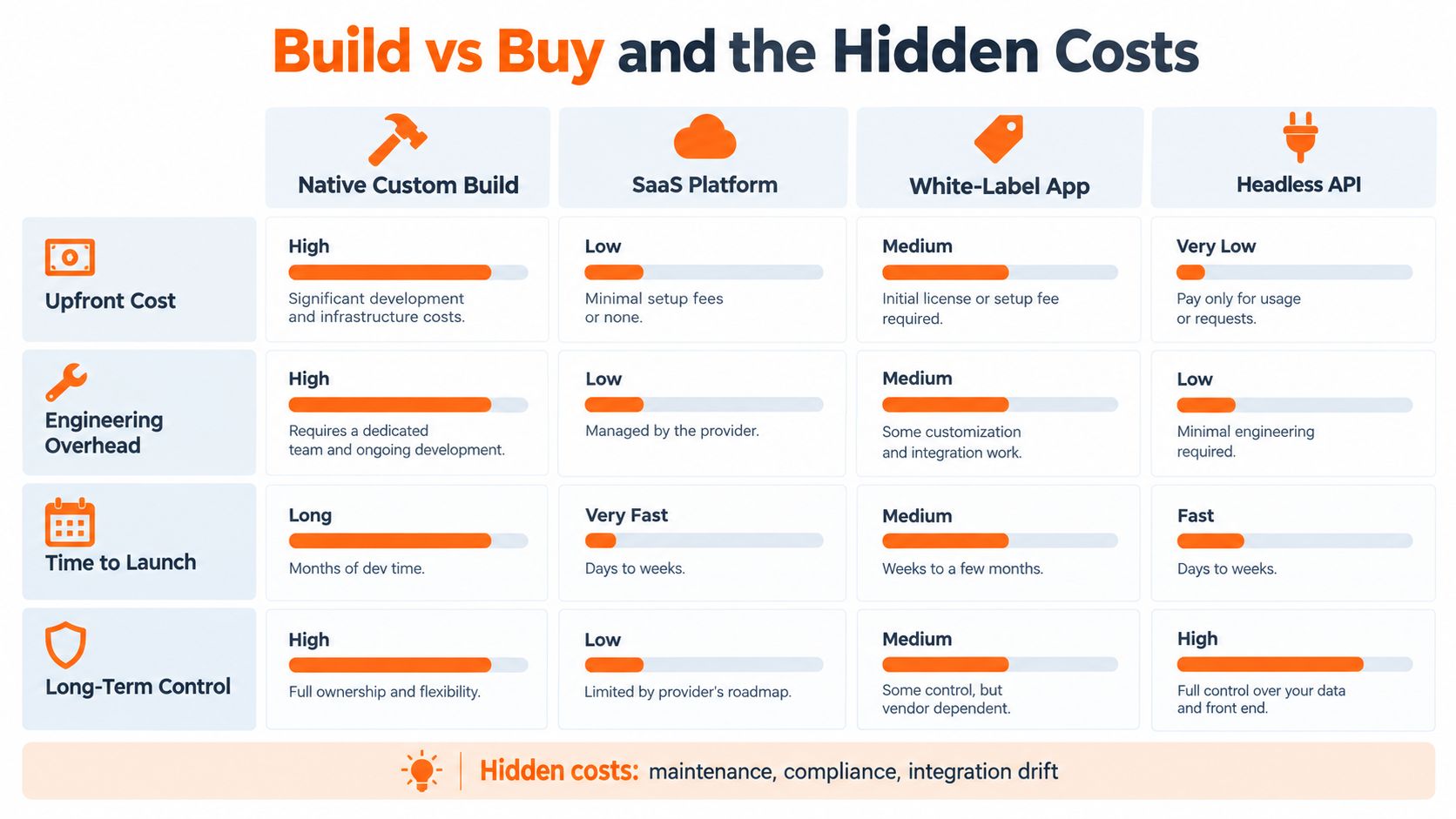
Build-versus-buy decisions become distorted when leaders compare a custom build's development quote with a platform subscription and stop there. The meaningful comparison includes time to first redemption, integration depth, data control, internal capability, and the cost of maintaining a customer-facing product.
A SaaS loyalty platform usually wins when speed and proven operations matter most. A white-label app can add branded presentation without requiring the business to own every layer. A headless API offers more control over the front end while outsourcing parts of the loyalty engine. A native custom build gives maximum control, but it also makes the business accountable for every dependency.
Compare the options by consequence
| Option | Best fit | Main advantage | Main exposure |
|---|---|---|---|
| Native custom build | Complex, differentiated customer journeys | Full control over experience and rules | Product and maintenance responsibility |
| SaaS platform | Fast validation and standard loyalty needs | Faster launch and managed infrastructure | Subscription dependence and platform limits |
| White-label app | Branded access without a full product team | Presentable mobile experience with less engineering | Customization boundaries |
| Headless API | Strong internal engineering and unique front end | Flexible experience across channels | Integration and operational complexity |
| App-less layer | Simple rewards and broad access needs | Low customer friction | Less room for rich app-based engagement |
The hidden costs rarely appear in the first proposal. They include design refinement, App Store submission cycles, accessibility work, analytics instrumentation, SDK updates, account recovery, privacy controls, testing across devices, payment-related integration work, and support for failed redemptions. POS and ecommerce systems also change, and every change can create integration drift.
The cheapest build is the one you don't have to rebuild after discovering that customers won't use it.
Questions for every vendor
Ask where the customer identity lives, how transaction events enter the system, and whether your team can export usable data. Ask how reward rules change without a release, how expired rewards are handled, how consent is recorded, and how staff recover an account when a customer changes a phone number.
Also ask to see the reporting interface, not a presentation slide. Can you isolate a cohort, compare a holdout group, calculate reward liability, and distinguish an identified purchase from an attributed purchase? If the answer is vague, the platform may produce attractive engagement numbers without proving business value.
How BonusQR Can Help
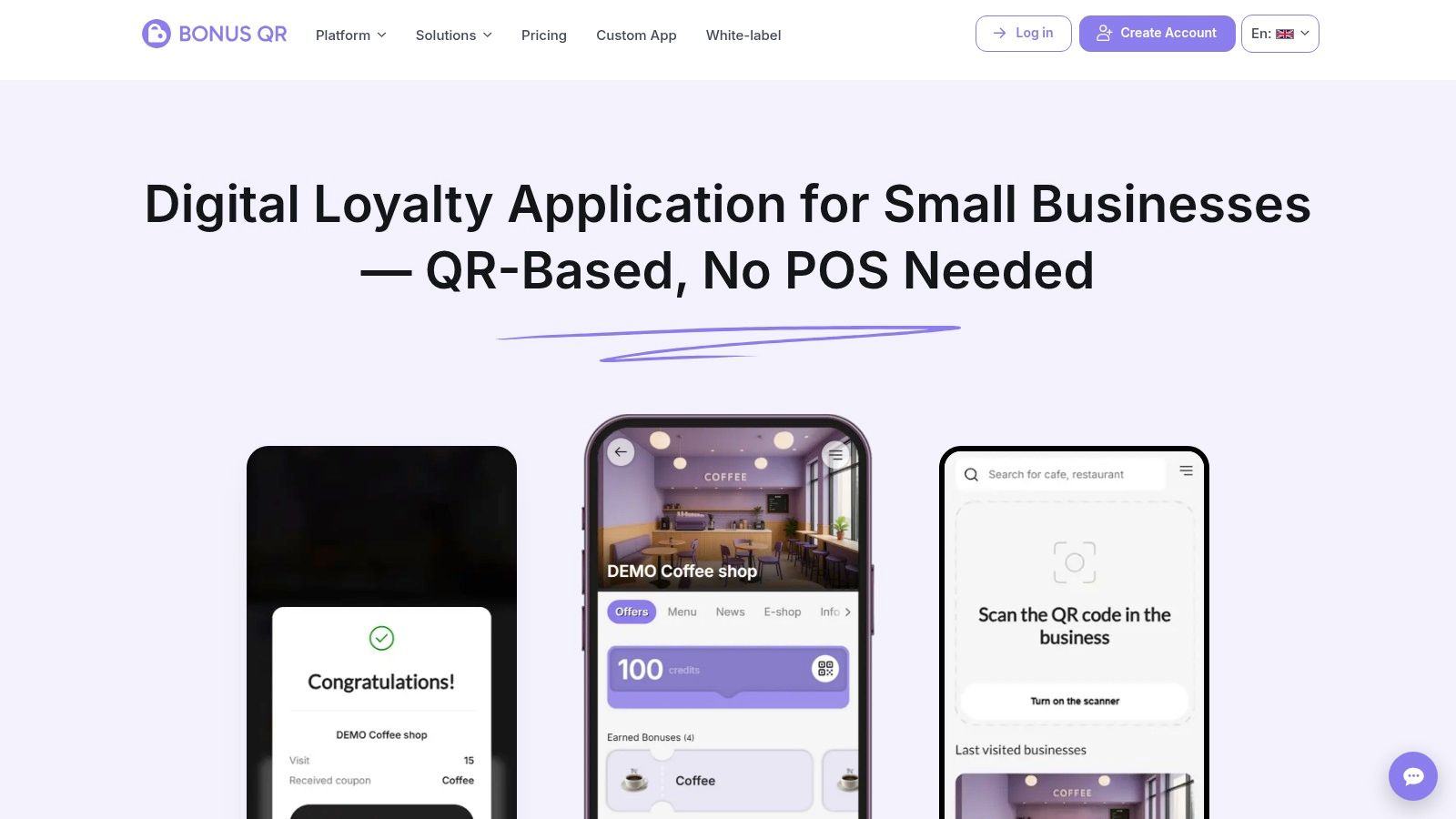
BonusQR is a practical option for businesses that need a working loyalty layer without immediately committing to a full native product. Its QR-based experience lets customers sign up through mobile or web, receive a personal QR code, and view points, rewards, and visit history in one profile.
The platform supports stamps, points, cashback, visit and spend thresholds, fixed discounts, welcome bonuses, birthday rewards, seasonal coupons, and mixed rule sets. That matters for operators who want to test reward economics before paying for a more elaborate product. Customers can also access menus or price lists, news, reviews, and reservations, while Google Wallet and Apple Wallet passes provide a fallback for people who don't want another installed app.
Where it fits best
BonusQR is strongest when the core problem is fast enrollment, simple redemption, and repeat visits, not a highly specialized enterprise architecture. Staff can scan and redeem without extra hardware or a required POS integration, and built-in analytics expose top customers, coupon performance, and visit trends. Automated push and email campaigns can then turn those signals into timely communications or feedback requests.
Businesses can start with the free option, use an affordable white-label app under their own icon, or commission a fully custom app with more advanced integrations. The provider describes a white-label launch in about 14 days on its custom loyalty app offering. Treat that timeline as a product-specific estimate to validate during procurement, especially if your workflows require custom approvals or integrations.
BonusQR is a sensible shortlist candidate for a local shop, hospitality operator, or multi-location business that wants to validate customer demand before funding a larger build. It isn't a substitute for due diligence. Test data export, consent handling, reward flexibility, staff workflows, and the quality of cohort reporting before making it the foundation of a broader retention program.
Must-Have Features and Integrations
A loyalty app should be judged by the work it enables, not by the number of tiles on its home screen. The right features reduce friction, improve decision quality, and help the team create profitable reasons to return.
Enrollment and identity
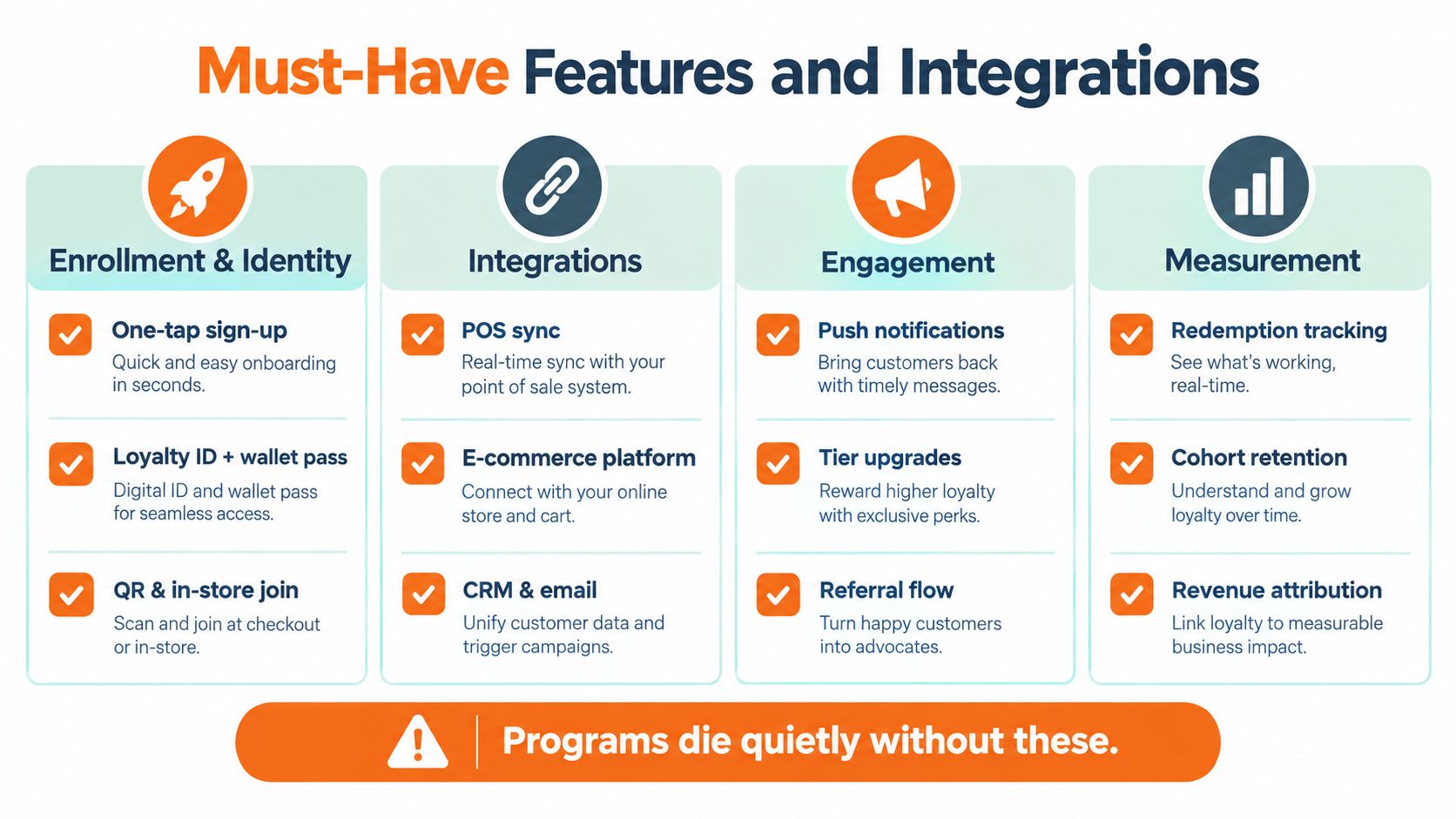
Make joining possible at the moment of purchase. QR enrollment, phone or email identification, wallet passes, and short forms should work together rather than force every customer through the same path.
A good test is simple: can a customer understand the benefit, join, and receive an identifier without staff explaining a complicated process? Your system should also merge duplicate profiles, support account recovery, and preserve consent history. An attractive app with unreliable identity data will produce unreliable personalization.
Integrations
The POS should send purchase and redemption events into the loyalty system with enough detail to support useful rules. Ecommerce, ordering, CRM, email, customer data platforms, and mobile wallets should connect to the same customer record wherever the business case requires it.
For teams coordinating loyalty communications with broader marketing activity, review practical guidance on integrating CRM with social automation. The principle is broader than social media. Every connected system should know which events occurred, which permissions apply, and which message the customer already received.
Engagement
Push notifications are useful for earned rewards, expiring benefits, service updates, and timely invitations. They become harmful when the business sends generic promotions without frequency controls or relevance.
Tier upgrades, birthday benefits, referrals, feedback requests, and milestone messages can create recognition without always reducing price. The rewards engine should support eligibility rules, exclusions, expiry, stacking controls, and audit trails. Staff need a fast redemption view, while customers need clear balances and understandable terms.
Measurement and privacy
At minimum, report enrollment, active use, earning, redemption, repeat purchase behavior, cohort retention, and margin after rewards. Revenue attribution should distinguish an identified transaction from a genuinely incremental transaction. Analytics need event-level detail, export access, and enough flexibility to support holdout tests.
Consent isn't a footer. Provide clear opt-ins by channel, preference management, deletion and access workflows, and rules that prevent marketing after withdrawal. Collect only the data the program can use responsibly. A smaller, trusted profile is more valuable than a large database customers don't understand.
Typical Costs and Tech Stacks
Exact budgets depend on scope, region, integrations, compliance requirements, and internal capability. Don't accept invented precision from a vendor before the requirements are clear. Instead, size the program by operational complexity and the amount of product ownership you want to retain.
Lean loyalty layer
A single-location business with simple rewards usually needs a QR or web experience, a customer profile, a small reward catalog, basic messaging, wallet support, and staff redemption. A SaaS platform or app-less layer is normally the rational starting point. The team may consist of an owner, an implementation contact, and a marketing operator rather than a permanent engineering group.
The launch objective is learning. Confirm that customers enroll, staff can process rewards, and the economics justify adding more automation.
Mid-market integrated program
A growing business with an existing POS and ecommerce operation may need a branded interface, richer segmentation, event-based messaging, wallet passes, analytics, account recovery, and bidirectional transaction synchronization. Cross-platform mobile development can reduce duplicated front-end work, while a headless loyalty service can support web, app, and in-store experiences.
The biggest cost sits in integration mapping, data quality, testing, security review, and operational ownership. Plan for product management, engineering, design, QA, analytics, marketing operations, and store or service training.
Multi-brand enterprise program
A multi-brand organization needs a more formal architecture. It may require shared identity with brand-level rules, centralized consent, separate reward catalogs, complex earn and burn logic, regional controls, role-based access, data governance, and a reporting layer that can separate brand behavior from portfolio behavior.
Native iOS and Android apps offer platform-specific control, while cross-platform frameworks can simplify shared experiences. Neither choice fixes poor loyalty logic. The backend, event model, experimentation layer, POS connectors, CRM integration, and analytics governance matter more than the language used to render the interface.
Use this cost comparison of automation platforms as a reminder to compare total operating requirements, not just the first invoice. Your sizing exercise should list channels, customer identifiers, transaction sources, reward rules, communication triggers, integrations, reporting needs, compliance obligations, and the people responsible after launch. If the team can't maintain the stack, simplify it.
Launch Playbook and Adoption Best Practices
A loyalty app launch is an operational rollout, not a press release. Customers won't adopt a program that staff can't explain, rewards that aren't ready, or redemption flows that fail at the counter.
Activate internally first
Train employees before public promotion. Give them a short explanation of the value proposition, a clear enrollment prompt, an account-recovery process, and a way to resolve failed scans. Test every reward with real staff accounts and real transaction paths.
Run a small beta with customers who visit often enough to notice problems. Watch where enrollment stops, which rewards confuse people, and whether staff skip the process during busy periods. Fix the workflow before buying broad awareness.
Remove the download trap
Let customers start earning through a QR code, web account, phone identifier, or wallet pass where possible. Present the native app as a better way to manage the relationship, not as a gate that blocks the first reward.
Use one clear in-store prompt. A sign should explain the immediate benefit, the action required, and where the customer will see the reward. Multiple competing calls to action create hesitation at exactly the moment the business needs speed.
Manage the first customer relationship
The first messages should confirm the account, explain the balance, show how redemption works, and deliver a useful next step. Later communications can introduce milestones, personalized offers, feedback requests, and reactivation messages. Give customers control over channel and frequency before your team starts increasing volume.
Track cross-channel identity carefully. Teams working across several touchpoints can use cross-platform user tracking best practices to reduce duplicate profiles and inconsistent attribution.
Launch criterion: Don't declare success when the app reaches the store. Declare success when staff can operate it, customers can use it without help, and the first cohort produces evidence of profitable behavior.
Watch for early fatigue signals: falling redemption quality, rising opt-outs, repeated support issues, reward use concentrated around discounts, and active members who stop purchasing after their first benefit. Those signals matter more than an attractive installation count.
Real Examples and Metrics That Prove Profit
A regional coffee chain can start with blanket discounts because they are easy to explain, but that approach rarely shows which behavior creates value. A stronger program gives each reward a job: recognition for frequent customers, a threshold reward for customers building a habit, and a reactivation offer for lapsed members. The custom loyalty app matters only if it helps the team test and manage those behaviors.
A multi-brand restaurant group needs a different view. App users may spend more across the company while distributing purchases among several brands, as the multinational study summarized by the University of Notre Dame illustrates. Management should measure brand concentration and contribution margin alongside portfolio revenue. Otherwise, a larger group total can hide weaker economics at individual brands.
A subscription-led consumer brand might use loyalty to support renewal, referrals, or product education instead of discounting every order. The app earns its place when it supports a retention hypothesis that subscription data can test.
The board-ready measurement set
- Cohort retention: Compare customers by enrollment period, acquisition source, first purchase, and reward experience.
- Redemption rate: Track reward usage and whether redemption leads to additional profitable behavior.
- Incremental contribution margin: Estimate margin created after reward costs and operating expenses.
- Reward liability: Monitor outstanding points, credits, or benefits that may be redeemed later.
- Holdout performance: Keep a comparable group outside the campaign or program so the team can estimate what would have happened without the incentive.
- Channel and brand effects: Identify changes in total customer value, channel mix, and full-price purchasing.
PwC's 2025 customer-experience research found that 57% of executives believed their loyalty systems weren't delivering the required outcomes, while 83% said they needed better tools to measure what drives purchases, according to PwC's customer experience survey. The same research reports that 57% of brand marketers identified technology-platform limitations as a major loyalty challenge, while 77% maintained or increased investment.
Those findings support a practical decision rule. Choose a custom loyalty app, an app-less layer, or a SaaS platform according to the profit hypothesis, identity requirements, incentive controls, and evidence the business needs. Downloads are a distribution metric. The board should see retention, incremental margin, liability, and holdout results.
If the dashboard cannot show whether the program changed profitable behavior, it is reporting activity rather than loyalty outcomes. Start by defining the behavior to change, the margin to protect, and the holdout test that will judge the result. Compare delivery options before committing to native development, then use Quuu to keep supporting social content consistent across channels with AI-assisted creation, scheduling, approvals, and reporting.